
 English
 Italy
Italy
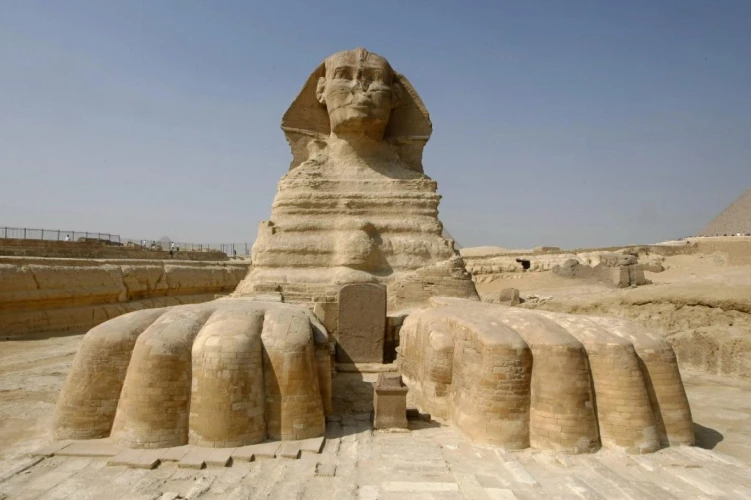
Lion, King, and Legend: The Story, Symbolism, and Rescue of the Great Sphinx
The Great Sphinx of Giza: The Eternal Guardian of Egypt's Secrets
Over four and a half millennia, a giant stone creature has lain pretty much calm on the golden sands of the Giza Plateau , staring in a fixed sort of way toward the rising sun in the east. With its strong couchant body, like a lion but still somehow royal, and the crowned head of an ancient Egyptian pharaoh, The Great Sphinx of Giza is probably the most recognized, iconic, and also oddly enigmatic monument in all of human history.
Carved right out of one single ridge of natural limestone bedrock, the Sphinx sits at an astounding 73 meters (240 feet) long, and 20 meters (66 feet) high. It is not only the oldest known monumental sculpture in Egypt it is also the largest monolithic statue on the planet, period.
However, even after centuries of heavy scientific scrutiny, archaeological digs, and basically nonstop global curiosity, the Sphinx still feels like it’s wrapped in this deep haze of mystery. Who shaped this mythical beast? Whose face is it really wearing? What holy function did it carry out, in the shadow of the great pyramids, and why there, at all?
Here comes the full, fascinating account of the Great Sphinx—its historical beginnings, its sacred symbolism, its famous retrieval from the sands , and those stubborn riddles that keep pulling people back, even now.
1. The Divine Identity: Who Built the Sphinx?
In popular culture, the origins of the Sphinx get argued over again and again, like people can’t fully agree, so it turns into a lot of off beat stories about vanished civilizations or some mythical era that never really ends. That said, most Egyptologists and geological field surveys point in the same direction to the Golden Age of the Old Kingdom, more precisely the reign of Pharaoh Khafre during the Fourth Dynasty (roughly 2558–2532 BC).
The case for Khafre
Even though the Sphinx itself doesn’t show any original royal lettering that clearly says who cut it, a few major archaeological clues still, link it closely to Khafre, who is also known as the builder of Giza’s second-largest pyramid.
Architectural integration: The Sphinx is placed inside a carved rock quarry along the paved causeway stone route that runs from Khafre’s pyramid mortuary temple over to his lower Valley Temple.
Facial features: When researchers compare the Sphinx’s face with confirmed representations of Khafre—like that well known diorite figure found not far away in the Valley Temple—there are noticeable matches in the facial build. think broad cheekbones and that same calm, kingly look.
The Sphinx temple: Right in front of the Sphinx, you can still see the scattered remains of the Sphinx Temple, made with huge limestone blocks taken from the ditch area around the monument during its creation.
2. Divine Symbolism: The Power of Lion and King
In ancient Egyptian religion and royal iconography, the lion was basically the final symbol of ferocious physical strength, authority, and solar power. Lions were imagined as guardians of sacred places, and kind of tied to the horizon where the sun does its daily disappearing and returning, day after day.
When the artists mixed the physical power of a lion with the intellectual authority, dignity, and divine mind of a king wearing the royal Nemes headdress, the sculptors ended up making a pretty forceful theological message:
The Living Horus, well, the Sphinx showed the pharaoh as Horus, the divine protector of the land, who keeps watch over the sacred royal tombs around the Giza necropolis.
Hor-em-akhet: By the New Kingdom era, the Egyptians started honoring the monument as a solar deity called Hor-em-akhet, meaning “Horus in the Horizon”, and in doing so they connected the statue very directly with Ra, the sun god. This was also because it faces the eastern horizon each morning .
3. Buried in the Desert: The Dream Stele and the Royal Rescue
Because the Great Sphinx was carved from a sort of natural dip in soft limestone bedrock it had, basically, a steady foe the entire time, the shifting desert sands. If nobody tended it, the winds from the Sahara would keep pushing in again and again, burying the body of the Sphinx up to its neck, and so it looked like some odd head was rising from the desert floor
The Dream of Thutmose IV
Around 1400 BC, in the Eighteenth Dynasty of the New Kingdom, there was a young prince named Thutmose who went hunting near the Giza Plateau. Worn out from the midday heat, he sat in the shade, right by the buried head of the Sphinx, and then he dozed off.
In that dream, the Sphinx spoke straight to him saying it was Hor-em-akhet, the god. It told Thutmose that, if he would scrape away the suffocating sands smothering its form, then it would reward him by giving the crown of Upper and Lower Egypt.
Thutmose did what was asked, he removed the sand and got the monument back to view. And because the divine word held true, he later climbed onto the throne as Pharaoh Thutmose IV. To mark what happened, he placed a huge red granite slab between the front paws of the Sphinx, and that slab is called The Dream Stele, you can still see it today when visitors come.






-webp.webp "Hilton")
-webp.webp "dusit")
-webp.webp "Marriott Hotels")
-webp.webp "Azimut Hotel")
-webp.webp "Golden Tulip")
-webp.webp "sheraton")
-webp.webp "westin hotel")
-webp.webp "Movenpick")