
 EN
 IT
 ES
 FR
 ZH
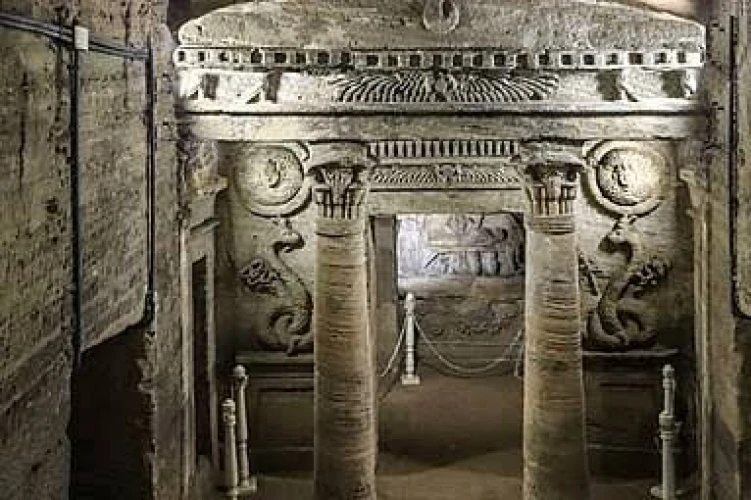
Kom El-Shoqafa Catacombs: Where Egyptian and Greek Art Meet
The ancient city of Alexandria, founded in 331 BCE by Alexander the Great, was the jewel of the Hellenistic world. A beautiful mixture of Greek, Roman and native Egyptian cultures can be seen nowhere better than in the Catacombs of Kom el Shoqafa. This large underground tomb built in the 2nd century CE in the historic Karmouz area of Alexandria is a prime example of the Graeco-Roman and Egyptian culture merging. It is made from limestone and has many levels within the ground. It combines native Pharaonic burial beliefs along with classical Greek architecture and Roman military detail. This will look at the accidental discovery, structure, beautiful artwork and significance of this amazing site.
1. Discovery and Background
As fascinating as the Catacombs of Kom el Shoqafa are there is also an interesting background to how it was discovered.
A. Accidental Discovery (1900)
Unlike the famous temples of Upper Egypt or the tombs of Tuna El Gebel, the Catacombs of Alexandria were completely forgotten about after the fall of antiquity. However, in November 1900, luck struck! An unsuspecting donkey was pulling a cart when it tripped and fell into a hole in the ground. This led the donkey to fall into the top section of the underground tomb. After contacting local officials and archaeologists such as Dr. Kamal el-Mallakh, the leading pioneer archaeologist and others, they explored the dark areas to discover an underground burial city.
B. Dating
From archaeological evidence and inscriptions we know that the Catacombs were first constructed during the late 1 st or early 2 nd century CE. This is during the peak of the Roman empire. The site was originally created as a luxurious family tomb, and then was expanded to include many more tombs, sarcophagi and cremation spots. The name Kom el Shoqafa, meaning ‘Mound of Shards’ in Arabic, is due to there being a large amount of broken pottery, plates and amphorae left behind by those visiting the tomb with food offerings.
2. Structure & Layout
The Catacombs of Kom el Shoqafa have 3 levels underground made entirely from limestone.
A. Spiral Staircase & Rotunda
Those wishing to enter the necropolis would enter through the large spiral staircase. This allowed light to enter from above and also the heavy sarcophagi made from stone to be lowered using rope and pulley systems. The ground floor consists of the Rotunda. This is a large round room with a domed roof and carved pillars. The main entrance.
B. Triclinium (Funeral Hall)
From the Rotunda, there is a large rock-cut room known as the Triclinium. This room contained 3 large stone couches carved from limestone with cushions. Family members would sit here when visiting the tomb. They could relax and eat while pouring their wine and oil into special channels. This created a link between the living and the dead, using classical Greek eating practices and Egyptian ancestor worship.
3. Artwork
The main reason Kom el Shoqafa is so significant to the world is because of the revolutionary artwork. This combines ancient Egyptian burial practices with classical Greek and Roman styles.
A. Merging Cultures
The lowest part of the underground tomb, now partially flooded due to rising water levels, contains the main burial area. The decoration within this room is exquisite.
Anubis wearing Roman Armour. As you enter the tomb you can see the jackal headed Egyptian god Anubis. He is the God of embalmment and leads souls to the afterlife. However, he does not wear his usual Egyptian clothing but instead uses Roman armour. He has a leather chest piece, soldiers tunic and a Roman Legion spear.
Osiris being Embalmed. The main artwork on the walls shows Osiris being embalmed onto the traditional funerary couch shaped like a lion. However, the artwork has been created using classical Greek methods. The muscular bodies, defined faces and flowing garments all follow Greek methods.
Agathodaimon (Serpent). On either side of the door are carvings of serpents wearing the Double Crown of Upper and Lower Egypt (Pschent). This is the God of good fortune and protection of the family. It combines with the Greek God Hermes and Egyptian Snake God Cneph.
B. Different Architectural Styles
Throughout the underground site there are many examples of merging styles. The columns have either Doric or Ionic capitals with the lintels carved with Egyptian inspired images. Winged suns, cobras (Uraeus) and lotus flowers. This shows how the artists and those who paid for the tomb saw Egyptian and classical cultures as one.
4. Burial Practices
The Catacombs contain a variety of burial practices due to the multi-cultural nature of Alexandria during the Roman era.
A. Sarcophagi & Loculi
The walls of the underground galleries show many niches known as loculi. These are rectangular and are used to place single bodies within linen or a basic coffin. Further into the tomb there are large sarcophagi made from stone. These are made from imported Red Granite and White Marble. This shows that the wealthy provincial elites, magistrates and rich merchants wished to be buried within these Catacombs.
B. Grave Goods
During the excavation of the Catacombs many interesting items were found. These included glass perfume bottles, mythological clay lamps, gold jewellery and offering plates. This shows how the everyday consumer culture of the Roman people existed alongside the serious Egyptian burial practices.
Conclusion
The Catacombs of Kom el Shoqafa is an immortal site showing the creativity of merging cultures. Combining the ancient Egyptian desire to reach the afterlife through Osiris with the classical Greek proportions and Roman military detail it created a unique masterpiece. This fascinating site still exists today under the busy streets of Alexandria. It continues to amaze people by showing how different cultures met, merged and achieved immortality through their artwork.