
 English
 Italy
Italy
King Scorpion: The Mysterious Ruler Who Paved the Way for Unified Egypt
King Scorpion: The Mysterious Ruler Who Paved the Way for Unified Egypt
When people think about ancient Egyptian kings, a few iconic faces pop up right away, like Tutankhamun with his heavy gold burial mask , Ramesses II and those huge monuments, or Cleopatra and her sharp political side. But, long before the well known dynasties showed up, long before the Giza Pyramids cut into the skyline and before the Pharaohs wore that joined double crown, there was a legendary ruler who led the Nile Valley under the shadow of something grim and tiny: King Scorpion.
He thrived in the late Predynastic era, mainly during Naqada III, often described as Dynasty 0 , (around 3200 BC to 3100 BC). At this exact turning point of human history, King Scorpion sits like a hinge in time. He wasn’t some mere myth, or a Hollywood invention at all, but more like a tough warlord, a practiced administrator, and a quiet sort of innovator. His rule helped pull separate tribal chiefdoms together, into what would become the world’s first centralized nation-state.
Here is the really gripping account of King Scorpion—how archaeology unearthed the evidence, what discoveries actually backed his existence, and why his legacy still echoes through the early formation of ancient Egypt.
1. One King or Two? Unraveling the Identity
For more than a century , egyptologists and archaeologists have been arguing about who King Scorpion really was. More recent digs and modern archaeological evidence imply that “Scorpion” probably wasn’t one single person, but rather two separate rulers, sort of overlapping in name, who ruled across those unsettled decades before the First Dynasty actually took shape.
King Scorpion I (c. 3200 BC)
The first of the two, Scorpion I, is often linked with an extraordinary burial arrangement, a whole complex, sometimes called Tomb U-j , found at the royal necropolis of Umm El-Qa'ab in Abydos, the place treated as sacred and rather tightly guarded by tradition.
The Tomb Discovery: This site was excavated by the German Archaeological Institute. It’s a multi- roomed mud-brick tomb that produced more than 200 tiny tags, made of ivory and bone. They were attached to trade jars, which is honestly a detail that makes the story feel less abstract.
The Birth of Writing: Those tags carried incised proto-hieroglyphic marks. The symbols recorded goods, amounts, and also royal agricultural domains, like “Estate of King Scorpion”. This huge find suggests Egyptian writing appeared far earlier than many people assumed before. It also seems to have started as a practical administrative method , used to handle state taxes and trade logistics during the time of Scorpion I, not just as some later ceremonial flourish.
King Scorpion II (c. 3100 BC)
The second ruler, Scorpion II, is thought to have lived closer to the reign of King Narmer, the well-known figure often described as the unifier of Egypt. He’s usually remembered less for a full tomb story and more for an artwork that still feels astonishing.
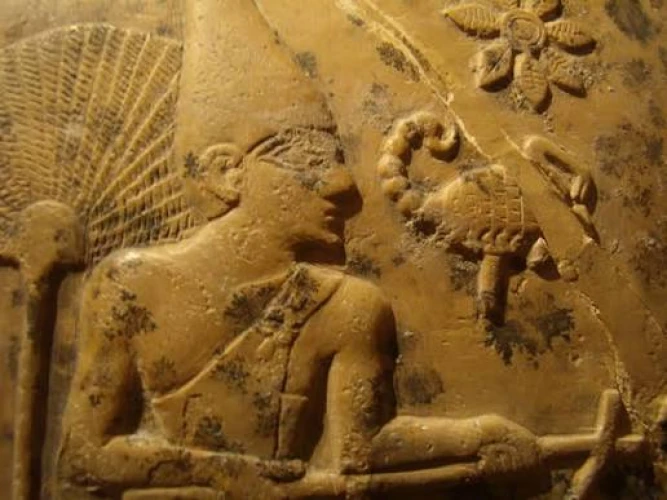
He is celebrated through The Ceremonial Scorpion Macehead, a masterwork of ancient art. It was found in the late 19th century at Hierakonpolis , also called Nekhen, and the object remains one of those “how did they even do this” pieces that draws attention from everyone.
2. The Ceremonial Scorpion Macehead: A Canvas of Early Power
Kept to today, in the Ashmolean Museum at Oxford, the Scorpion Macehead is a pear-shaped limestone weapon end carved with very intricate relief images. It works as one of our more precious kinds of historical evidence from Dynasty 0, but also somehow feels personal even now.
The Sacred Ditch and Hoe
In the middle of the carving stands King Scorpion II, rendered larger than everyone else , which is kind of an early, clear use of “hieratic scale” that ended up shaping Egyptian royal art for the next 3,000 years or so.
The White Crown
He wears the high, bulbous White Crown (Hedjet) which marks him plainly as the supreme ruler of Upper, Southern Egypt.
Agricultural Ritual
In his grasp he holds a heavy wooden hoe. He seems to be digging a ceremonial irrigation trench, or maybe breaking ground for a sacred structure, either way the action is meant to look deliberate and ritual, not random. Around him, water channels are shown flowing, and there are attendants with baskets plus palm fronds. This scene stresses a key point about early kingship: the ruler wasn’t merely a military conqueror, but a supreme guardian of farming, abundance, and Nile irrigation, kind of like the whole landscape depended on him.
Symbols of Conquest and Royalty
Right before the king’s face sits a finely worked scorpion symbol. It’s set beneath a seven-pointed star, or a flower-like rosette, depending how you read it. This functioned as his royal sign before cartouches were invented. Above the scene, you can see regional standards hanging, decorated with lapwings , those birds that were often used to suggest conquered groups or particular geographic areas. Together they suggest Scorpion’s campaigns, military wins, and his political control over nearby territories.
3. The Political Landscape of Dynasty 0
To get a real sense of King Scorpion’s historical weight, you sort of have to see how wildly chaotic 4th-millennium BC Egypt was . North Africa was drying out fast, and that pushed nomadic groups , plus agriculturalists, to bunch up in a much tighter way along the Nile floodplain.
So yeah, this population surge translated into intense rivalry over fertile ground, over key trade corridors , and over whatever natural resources people could grab. In response, Upper Egypt kind of fractured into three main power centers, not all peaceful either :
Abydos: the spiritual and funerary core, where rites mattered and burial traditions held sway.
Naqada: a well-off hub that managed the Eastern Desert gold routes.
Hierakonpolis: a militaristic powerhouse, with a strong dedication to the falcon-god Horus and all that comes with it.
King Scorpion didn’t just “rule” from somewhere neutral. He operated straight out of these southern strongholds. Through carefully built trade connections, control over river shipping, and also aggressive military moves, he welded influence across Upper Egypt. Then he kept pressing his authority northward toward the fertile Nile Delta, and southward into Lower Nubia. In a way, he set the stage so that his successor , King Narmer, could seize final momentum and unite the Two Lands.
4. Innovations Under Scorpion's Rule
King Scorpion’s reign was, kinda defined by huge forward steps in statecraft, technology, and culture, all at once, not too cleanly. In Tomb U-j , the bone tags basically show how his people mapped regional tribute, counted grain reserves, and moved imported oil along, plus wine that came in from Canaan and the Levant too.
Also there was this monumental iconography vibe: Egyptian motifs of divine kingship were made more uniform during his years. The ruler wearing the bull’s tail, holding ceremonial tools, doing those agricultural observances, and crushing foes—these images were more or less codified into a system. You could say it was less “random display” and more deliberate, symbolic engineering.
And then there’s the early state religion angle. The link between the earthly ruler and divine cosmic forces—like Horus the falcon god, and Selket the desert goddess—grew firmer under his direction, almost like it became official doctrine or at least the expected story everyone had to live with.





-webp.webp "Hilton")
-webp.webp "dusit")
-webp.webp "Marriott Hotels")
-webp.webp "Azimut Hotel")
-webp.webp "Golden Tulip")
-webp.webp "sheraton")
-webp.webp "westin hotel")
-webp.webp "Movenpick")