
 English
 Italy
Italy
Karnak Temple Guide: The Hypostyle Hall, Sacred Lake, and the Opet Festival
Karnak Temple: The Supreme Sanctuary of Amun and the Heart of Ancient Egypt
On the eastern side of the Nile River, in today’s Luxor, there sits what people often call the largest religious complex ever made by human hands: the Karnak Temple Complex. The ancient Egyptians, they knew it as Ipet-sut, which is sort of translated as “The Most Select of Places”, and honestly it was not just one temple, or some calm little place for prayer. It turned into this wide, sprawling city of gods, an epicenter of royal might, and the spiritual core of an empire that went on for more than two thousand years.
For over 1,500 years, almost every big pharaoh from the Middle, New, and Greco-Roman periods left behind a physical trace at Karnak. They raised tall obelisks, built heavy pylons, set up statues, and enlarged impressive halls, until it felt like a living archive of Egyptian history written stone after stone, and then again stone.
So here’s the complete story of Karnak, with its sacred layout and the truly stunning architectural sights, plus its part in royal ceremonies and huge festivals, and finally the way it still carries an ancient kind of magic, like a miracle that never really fully fades.
1. The Sacred Heart: Dedication to the Theban Triad
While Karnak housed shrines for all kinds of deities, the whole complex was basically laid out with one main idea, the worship of the Theban Triad , kind of like the true core of it all:
Amun-Ra, the King of Gods, supreme maker, and patron deity for the Egyptian Empire.
Mut, the divine mother goddess, lioness protectress, and queen of the gods, who sort of holds everything together.
Khonsu , the god linked to the moon, time, and healing, shown as the divine son of Amun and Mut.
The main enclosure, the Precinct of Amun-Re, sits over 200 acres by itself, so it becomes the key focal point for the entire complex, without really needing competition.
2. Architectural Marvels: Walking Through the Sacred Stone
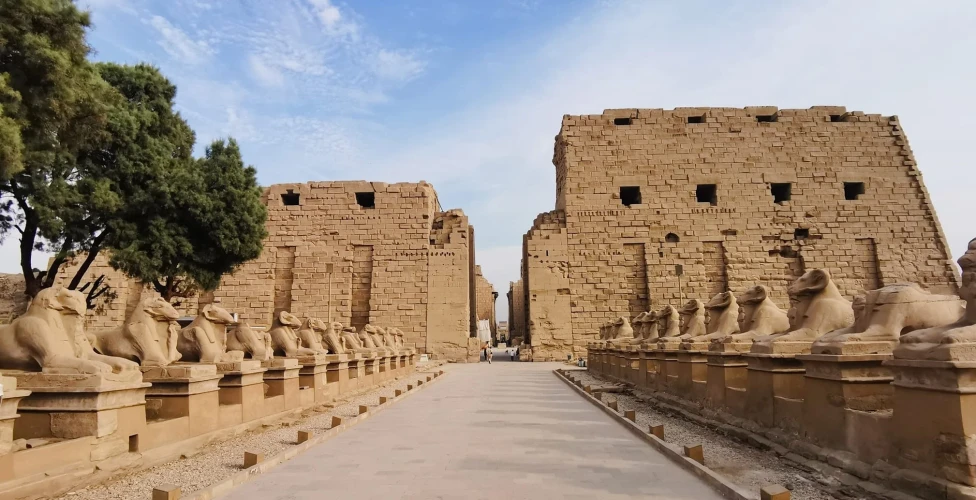
Entering Karnak feels like this immersive step back into that peak, pharaonic grandeur, you know, where everything just sort of overwhelms you a little. The temple complex was laid out along two main axes, an East-West line following the sun’s path across the sky, and a North-South line that ties Karnak to its sister temple at Luxor, as if the stones themselves are keeping appointments.
The Avenue of Sphinxes
Before you even get close to the massive First Pylon, visitors move through a long avenue lined with ram-headed sphinxes. The ram, sacred companion of Amun, stands for protective leadership, that masculine steadiness, and fertility too, even if you don’t think about it for long. Each sphinx kind of guards a small statue of the pharaoh, positioned right between its paws, under the deity’s chin area, like a quiet, specific kind of promise.
The Great Hypostyle Hall
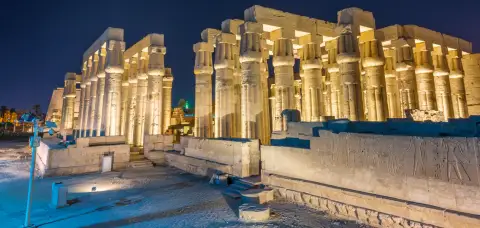
Built during the 19th Dynasty under Pharaohs Seti I and Ramesses II, the Great Hypostyle Hall still counts as one of the most impressive structural feats in world architecture, really.
134 Soaring Columns : Set in 16 rows, these heavy sandstone pillars look like a dense forest of papyrus plants rising out of the primeval waters of creation (Nun).
Towering Heights : The middle 12 columns reach about 70 feet, or 21 meters, and the capitals are broad enough that 50 people could stand on top of a single column at the same time, somehow.
Lattice Windows : Far above, stone lattice clerestory openings let sunlight beams cut into the dim, cool space, and the carved reliefs become visible, showing the king making offerings to the gods, bit by bit.
The Piercing Obelisks
Karnak was especially known for its grand pink granite obelisks. These were carved from single blocks of stone at Aswan, then transported down the Nile, carefully, piece by piece and by sheer will. The most well known surviving obelisks are linked to Thutmose I and also to his daughter, the female pharaoh Hatshepsut. Her obelisk rises to nearly 100 feet, and in earlier times it was capped with gleaming electrum, that gold silver alloy, intended to catch the very first glint of dawn, reflecting the sun
3. The Sacred Lake: Purification and Cosmic Renewal
To the south of the main sanctuary there is the Sacred Lake, a big rectangular stretch of water that is fed straight from the natural groundwater connected to the Nile.
The lake wasn’t just decorative, it really had key religious duties, day after day…
Priestly Rituals: the high priests had to bathe in those sacred waters four times, yes. Twice before dawn, and twice through the night, as a kind of purifying step before they could enter the inner sanctum of Amun.
Ritual Navigation: in the sacred night ceremonies golden model boats, with statues of the gods aboard, were guided across the lake, so the priests could reenact those creation myths, like the cosmos being made again.
Near the lake there’s also a massive stone scarab, built by Amenhotep III and dedicated to Khepri, the god of the rising sun. People say that going around the scarab, kind of circling it, brings good fortune, steadier health, and a fresh start.
4. The Opet Festival: Rejuvenating the Divine Pharaoh
Karnak was kind of the place where it all began, for the big annual religious happenings in New Kingdom Egypt, you know, the Opet Festival.
It took place during that yearly inundation stretch, when the Nile flooded the fields and made everything feel new again. The whole idea was to sort of “refuel” the spiritual bond between the pharaoh and his divine parent, Amun-Ra , so the ruler and the god stayed in sync.
So first there was the Procession: the sacred golden statues of Amun, Mut and Khonsu were taken out from the dim inner sanctuaries of Karnak and set into fancy ceremonial river barges, not just any boats but the kind meant to feel official and sacred.
Then came the Voyage to Luxor Temple , escorted by priests, military guards, musicians, dancers, and also those thousands of cheering citizens. The barges either floated down the Nile, or , depending on the arrangements, were transported along the two-mile land route toward Luxor Temple, called Ipet-resyt.
And finally there was the Divine Rebirth: deep inside Luxor Temple, hidden rituals were carried out, to shift divine royal power, the Ka, into the living pharaoh. That was supposed to make sure the next year brought prosperous harvests , military success, and general stability, meaning Ma’at.
-card_webp.webp "Giza Pyramids")
-card_webp.webp "Giza Pyramids in Egypt")




-webp.webp "Hilton")
-webp.webp "dusit")
-webp.webp "Marriott Hotels")
-webp.webp "Azimut Hotel")
-webp.webp "Golden Tulip")
-webp.webp "sheraton")
-webp.webp "westin hotel")
-webp.webp "Movenpick")