
 EN
 IT
 ES
 FR
 ZH
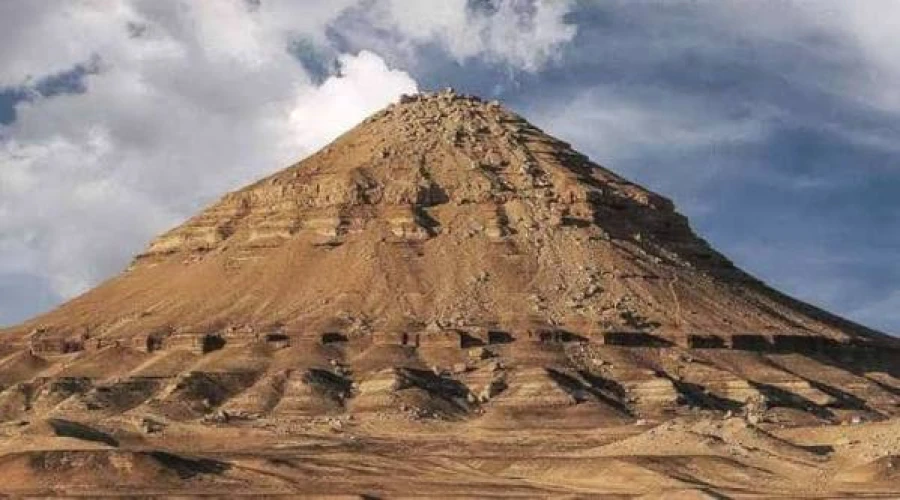
Jabal Al-Ingliz: A Strategic Lookout and Historical Landmark in Bahariya Oasis
Jabal Al-Ingliz (the English Mountain) is one of the most well-known natural features and contemporary sites within Egypt's Western Desert. Situated on the outskirts of oasis centre El-Bawiti, this dark topped hill is topped by the remains of a First World War British military site and provides impressive views over the oasis basin. As well as impressive desert vistas, it also maintains a fascinating link between the ancient trans-Saharan trade network and world events in the early 20 th Century.
1. Natural Features
Composed of striking volcanic and iron rich sandstone, Jabal Al-Ingliz has a dark basaltic top which dramatically contrasts with the yellow sands and emerald palm tree plantations below within the oasis. Having been shaped by volcanic and aeolian (wind) processes over millions of years, the hill has a steep sided, rocky exterior and a relatively level summit area. It rises about 100 metres above the surrounding valley floor.
Given its remote location on the northern fringes of El-Bawiti, Jabal Al-Ingliz functions admirably as a watchpoint, affording 360 degree clear lines of sight. From the summit one can view the whole Bahariya basin, together with its meandering village streets, cultivated areas, further away rock faces and surrounding cone-shaped, black topped hills which are responsible for the unique colouration of the adjacent Black Desert.
2. First World War and Military Site
During the First World War (1916-18), the oasis was fought over as part of the Senussi Campaign. Pro-Ottoman and Senussi forces invaded Libya and then marched into western Egypt. Temporarily seizing control of Bahariya Oasis, they posed a threat to British access to the Nile Valley.
Once the British Imperial forces re-took Bahariya Oasis, military experts then set up a strongly defended observation and military site on top of this key hill. Led by Captain Claude Scudamore Jarvis (later Governor of Sinai), the British built simple stone block buildings, watchtowers and defence barriers on the summit using the locally available dark stone. Soldiers used the high point to keep a watch for trans-desert caravans and enemy figures moving over the dunes. Communication was also enabled between this site and adjacent desert outposts by heliograph and wireless systems.
3. Remaining Buildings
Individuals today can physically stroll around the aged stone remains of the early 20 th Century military facility. This comprises a number of rectangular stone buildings, boundary walls, store rooms and watch towers which have been skillfully adapted to fit the natural landscape of the rocky summit.
Whilst wooden upper storeys and weaponry were long ago taken away from the site after the war had ended, the dry desert environment has allowed the substantial stone construction to remain in excellent condition. People can therefore really appreciate the loneliness, heat and difficulties encountered by military personnel stationed so far into the Sahara more than a century ago. Interestingly, this is in sharp contrast to the ancient Egyptian and Greco-Roman artefacts which are maintained in the oasis valley floor.
4. Oasis Importance
Generally speaking, within the Bahariya Oasis, Jabal Al-Ingliz symbolically links the past with the present. Even prior to the British military constructing a defence system upon its summit, ancient nomads, merchants and Romans utilised the same key desert geographical features to aid their journey along the demanding terrestrial transport network between the Nile Valley and Siwa, Farafra and Libya. Due to its dominant location, Bahariya was consistently recognised by different eras of civilisation as both a productive farming region and as a key strategic point within the Western Desert.
5. Information for Visitors
Visiting Jabal Al-Ingliz is a major attraction for people on cultural or desert themed trips to the Bahariya Oasis. It can conveniently be linked with other nearby points of interest such as the Temple of El-Muftella, El-Bawiti's Golden Mummies Hall and the Twenty-Sixth Dynasty Tombs of the Nobles in Qaret el-Subi.
To reach the foot of Jabal Al-Ingliz, one simply needs to drive for a brief period from central El-Bawiti. A moderately challenging trek then follows along a stoney track to the summit. It is advisable to wear firm, sealed footwear with strong traction. Individuals must also ensure that they have adequate water and sun screen applied as the dark basalt stones become hot during the day.
The best time of day to visit is around an hour before sunset. As the sun sets behind the western rock wall, a glorious golden hue radiates over the entire oasis, including palm trees, mud-built villages and encircling desert hills. This makes for a truly memorable conclusion to a day's exploration of the oasis' historical and natural attributes.