
 English
 Italy
Italy
Inside Ipet-resyt: How Pharaohs Claimed Their Divine Right to Rule
Luxor Temple: The Southern Sanctuary of Royal Power and Rebirth
On the eastern bank of the Nile River, in the middle of modern Luxor there is one of those truly stunning, elegant, and somehow uninterrupted monuments from ancient Egypt : Luxor Temple. The ancient Egyptians called it Ipet-resyt, or “The Southern Sanctuary” and while that sounds straight forward enough, the whole place is different from most other temple complexes you might see. It was not really meant for a dead pharaoh’s funerary cult, and it also wasn’t built mainly for everyday offerings to some local deity.
What it was, instead, was a grand stage for pharaonic divine legitimacy. It became the sacred ground where the earthly ruler was spiritually reshaped, kind of joining with the divine royal soul, the Ka, so that he could receive the legitimate right to govern the Two Lands of Egypt.
So this is the complete story of Luxor Temple , its massive architecture, its role in the annual Opet Festival, the way its walls hold layers of multi religious history, and the quiet, lasting beauty it keeps on the Nile banks, even now.
1. The Core Purpose: The Palace of the Divine Royal Ka
To get Luxor Temple right, you kind of have to grab the old Egyptian idea of divine kingship, because otherwise the whole place feels like it is just stones. The Egyptians thought that a pharaoh carried two sides to their existence, not just one. There was a human, physical body that aged, then died, and alongside it an immortal divine presence, often described as the Royal Ka.
The Ritual of Rebirth
In a very practical but also sacred way Luxor Temple functioned as a kind of sacred womb where the union was renewed again and again:
The Living Vessel: deep within the silent, dark inner sanctuaries of Ipet-resyt, secret rites were done, so the lasting Ka could be moved into the material body of the reigning king.
Confirming the Crown: by means of this spiritual rebirth, the pharaoh became official in the highest sense, not merely a political ruler, but a living embodiment of Horus , and also the direct child of the top creator god, Amun-Ra.
Every pharaoh who wanted to lock in both legal standing and sacred power , including female rulers like Hatshepsut and even outsiders such as Alexander the Great, made certain to restore, extend, or carve their names into the walls of Luxor Temple.
2. Architectural Greatness: A Journey Through Millennia of Stone
Luxor Temple was mostly put together by two some of ancient Egypt ’s most impressive royal builders, Amenhotep III from the 18th Dynasty and Ramesses II from the 19th Dynasty.
The Entrance Pylon and Colossal Statues
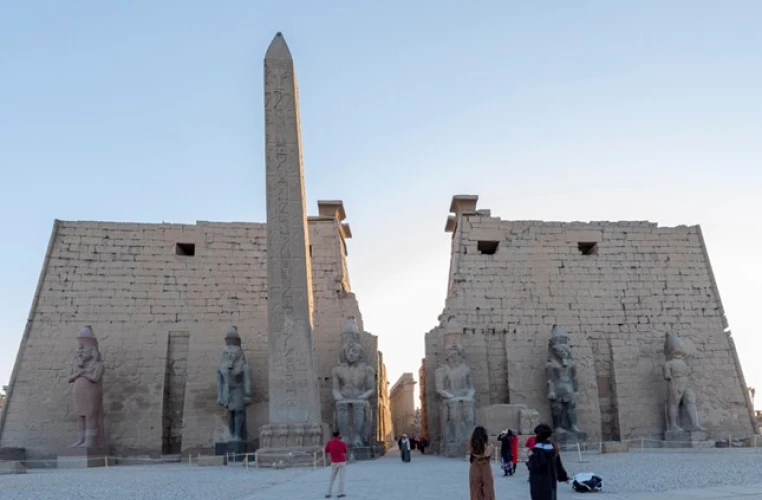
So when you approach the temple, visitors are basically welcomed by a huge front pylon, Ramesses II built that part.
The Colossi of Ramesses II: On both sides of the heavy entry doorway are enormous seated and upright statues of Ramesses II, carved from solid black granite , and red quartzite too, showing the king in a kind of calm grandeur.
The Twin Obelisks: In the beginning, there were two tall pink granite obelisks right in front. The eastern one is still here at Luxor Temple, but the western obelisk was handed over to France in the 1830s, by Muhammad Ali Pasha, and now it stands confidently at Place de la Concorde, Paris.
The Colonnade Hall of Amenhotep III
If you pass through the first courtyard, you reach one of the more atmospheric rooms of ancient architecture, the Grand Colonnade Hall :
14 Soaring Pillars: Amenhotep III built this hall, and it has 14 columns with open-papyrus capitals, each is more than 50 feet, about 16 meters tall.
Vivid Reliefs: The walls around you are filled with detailed relief carvings, they seem to move, like music scenes , dancers, cattle offerings, and ceremonial river barges from the grand Opet Festival procession.
The Sun Court and Hypostyle Hall
Past the colonnade there is the wide open-air Sun Court of Amenhotep III, it is bordered on three sides by double rows of delicate papyrus-bundle columns . From there you enter an inner Hypostyle Hall and then smaller, quieter sanctuaries, where the sacred statues of the gods stayed during religious ceremonies.
3. The Heartbeat of Thebes: The Opet Festival
Luxor Temple was sortof the place where the grandest yearly celebration happened in New Kingdom Egypt , the Opet Festival , yes.
At the height of the Nile’s annual flooding season, when farming work practically stopped, the whole population of Thebes showed up along the riverbanks and joined in a month long celebration , mostly about life , plenty, and a kind of royal re-starting.
How it began from Karnak: the sacred statues of Amun-Ra , along with his wife Mut, and their son Khonsu were brought out from the inner shrines of Karnak Temple. They got set inside golden ceremonial barges , then floated down the Nile , or moved along the two mile land avenue , depending on the procession.
What happened inside Luxor: inside the inner sanctum of Luxor Temple, the pharaoh and the high priests carried out private , sacred acts that refreshed the king’s divine power and helped bring back fertility to the land of Egypt again.
Celebration for everyone: Beyond the temple walls, the festival turned into a loud, lively carnival. Thousands of citizens received free rations of bread, roasted meat, and beer from the royal granaries, and all around them musicians, acrobats, and dancers kept the air full of music and motion.





-webp.webp "Hilton")
-webp.webp "dusit")
-webp.webp "Marriott Hotels")
-webp.webp "Azimut Hotel")
-webp.webp "Golden Tulip")
-webp.webp "sheraton")
-webp.webp "westin hotel")
-webp.webp "Movenpick")