
 English
 Italy
Italy
Inside Djeser-Djeseru: How Egypt’s Female Pharaoh Built a Masterpiece
The Mortuary Temple of Hatshepsut: Djeser-Djeseru, the Architectural Wonder of Deir el-Bahari
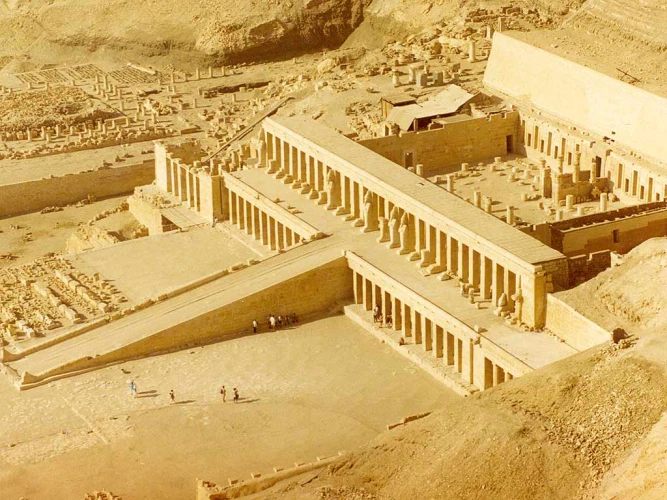
Against those towering, sunbaked limestone cliffs of Deir el-Bahari up in Upper Egypt there is one of the most astonishing masterpieces of ancient architecture, The Mortuary Temple of Hatshepsut. In antiquity it was called Djeser-Djeseru, which is “Holy of Holies” or close enough to that meaning depending on how you phrase it. This huge terraced place was built for Pharaoh Hatshepsut herself, one of the rare female pharaohs who ruled Egypt with full authority, right when the New Kingdom was at its peak.
It was shaped by her very capable royal architect and also a trusted close advisor, Senenmut, and even if you look at it quickly you can feel the balance of everything, harmony, geometry and that almost careful merging with the environment. Most older pharaonic temple plans, they lean hard on massive, closed pylons, you know, thick walls meant to block the view. But Hatshepsut’s sanctuary, it slips into the cliff, like it was always part of the stone. So the whole site keeps a kind of visual conversation between human making and desert landscape, not just a hard domination but more like a dialogue.
So here it is, the complete story of Hatshepsut’s temple. What makes the design different, the lively historical reliefs that still catch your eye, the sacred shrines tucked into the terraces and how it managed to survive all those centuries of political efforts to scrub it out of memory, and somehow it didn’t fully disappear.
1. The Woman Who Ruled as King: Hatshepsut's Legacy
To really appreciate the grandeur of Djeser-Djeseru, you first kinda have to understand the extraordinary woman who made it possible. After the death of her husband Thutmose II, Hatshepsut initially served as regent for her young stepson, Thutmose III. But within a few years, she did something almost nobody had tried before , she took the unusual move of declaring herself full pharaoh.
Legitimizing her divine right
She ruled in a time when kingship was considered a male affair, so Hatshepsut leaned on art, architecture and religion, to really lock in her legitimacy.
Adopted pharaonic iconography: she commissioned statues showing herself in the traditional royal nemes headcloth, the ceremonial false beard, and that pharaonic kilt, you know the classic look.
The divine birth myth: she claimed she was not simply royal by birth, but the direct , literal daughter of Amun-Ra, who had visited her mother Queen Ahmose in divine shape.
Her mortuary temple at Deir el-Bahari, was designed to highlight this divine lineage, to host her funerary cult, and to stand as a lasting monument celebrating her “peaceful, prosperous” two-decade reign.
2. Architectural Genius: The Terraced Wonder of Deir el-Bahari
Built up over something like fifteen years in the 18th Dynasty, the temple’s layout was kinda revolutionary for its era. Instead of copying those sprawling, horizontal plans people associate with Karnak or Luxor, Senenmut went for a multi-layered arrangement, with three huge , open-air terraces, and they’re tied together by broad central ramps.
The Lower Terrace and Courtyard
At first, visitors came in through a long avenue, lined by sphinxes and then all this lush green landscaping, with foreign trees, pools , and a general sense of being guided inward:
The Processional Approach: the lowest tier met worshippers in a large courtyard, bordered by double colonnades, like a kind of formal embrace.
Hunting and Transportation Reliefs: the carvings along the lower porticos show quarrying giant granite obelisks at Aswan, then moving them down the Nile to Karnak, on massive wooden barges.
The Middle Terrace: a history carved in stone, kinda quietly but still loud
When you climb the broad central ramp it takes you to the middle level, and there are two of the most historically famous porticos in ancient Egypt there, tucked in like a statement you only notice after you get closer.
The Birth Colonnade: these detailed relief carvings show the divine birth story, with Amun-Ra declaring that Hatshepsut would govern the Two Lands with wisdom and strength. It’s all there, in images that feel almost like they’re breathing.
The Punt Colonnade: this one is a stunning visual record, of Hatshepsut’s well known trade expedition to the faraway land of Punt , which is usually linked to modern day Somalia/Eritrea. The reliefs show Egyptian sea vessels cutting across the Red Sea, bringing back exotic wares—gold, ebony, panther skins, and even myrrh trees with rooted soil balls meant for planting near the temple entrance, like they’re being restored rather than just transported.
The Upper Terrace and the Inner Sanctum
Up top, the whole place shifts into something more sacred, the most serious zone across the entire complex.
The Sanctuary of Amun-Ra: carved right into the solid rock face of the mountain, this dark, solemn sanctuary held the sacred boat shrine of Amun-Ra during annual religious festivals. You can almost feel how still it is inside.
The Royal Cult Chapels: dedicated to Hatshepsut and her father, Thutmose I, these chapels were where priests carried out daily rituals and offerings, to sustain their eternal spirits, (Ka).
3. Sacred Shrines of the Goddesses
Hanging around the big terraces there are two kinda special chapels, each one given over to protective deities with a really personal meaning for Hatshepsut, not just some general ritual stuff.
The Chapel of Hathor
This one is set on the southern side of the middle terrace, a shrine to Hathor , goddess of beauty and affection , joy , plus that maternal kind of protection :
Hathoric Columns: Inside, the columns show the calm, composed face of Hathor, carved with bovine ears , and she seems to stare out toward the desert valley, like quietly guarding everything.
Protector of the West: She was also known as “Lady of the Western Mountain” , and people thought she welcomed the souls of the dead into the afterlife, so this little place becomes an important part of the funerary complex.
The Chapel of Anubis
On the northern side you’ll find the shrine of Anubis, the jackal-headed god tied to mummification, and also the guardian of the dead. The chapel keeps exceptionally well preserved, and honestly the pigments are still vibrant, with colorful markings of Hatshepsut offering wine , incense, and fine linen to Anubis, and also to Ra-Horakhty.





-webp.webp "Hilton")
-webp.webp "dusit")
-webp.webp "Marriott Hotels")
-webp.webp "Azimut Hotel")
-webp.webp "Golden Tulip")
-webp.webp "sheraton")
-webp.webp "westin hotel")
-webp.webp "Movenpick")