
 English
 Italy
Italy
Holy Family Route and Coptic Heritage: A Cultural Journey
Egypt is known as a cradle of history and spirituality. Even though the world admires ancient Egypt and its Pharaohs, Egypt boasts a unique Christian cultural and artistic legacy that dates back to the very beginnings of Christianity. The heart of this legacy is the Holy Family Route, a 3,500 km long pilgrimage trail, following the flight of the Virgin Mary, Joseph the Carpenter and the young Jesus into Egypt.
According to the Gospel of St. Matthew, in order to save the infant Jesus from the King Herod, the Holy Family fled Jerusalem and arrived in Egypt through the desert of Sinai. They have taken refuge in the fertile Nile Delta, the bustling cities of Old Cairo, the desert monasteries of Wadi El-Natrun, and the cliffs of Upper Egypt. Their journey through the country took more than three years, making Egypt a land of safe haven for the Holy Family.
1. The Heritage of the Nile Delta
The journey of the Holy Family through Egypt began along the northern borders of Sinai before heading west towards the agricultural settlements of the Nile Delta. The many places of worship built in this region reflect the local ancient traditions, local hospitality and miracle stories.
Tell Basta and Mostorod
Ancient legends tell us that on entering Tell Basta (ancient Bubastis) pagans’ statues rolled on the ground at the sight of the infant Jesus and a spring of fresh water was blessed by him for the Holy Family to drink from. Closer to the modern day city of Cairo, near the northern suburbs is Mostorod, known locally as Al-Mahamma (the place of bathing). It is told that here, the Virgin Mary bathed the infant Jesus and his clothes. Today the Church of the Virgin Mary stands on the site of the ancient cave and well which still offer shade and refreshment to visitors and pilgrims.
Samannoud and Sakha
Further into the Delta lies Samannoud, where the local townsfolk welcomed the Holy Family with simple but warm hospitality. In the fascinating Church of the Virgin Mary and Saint Abanoub you can see the large granite trough, which the Mother Mary used to bake bread in and the well of blessed water. In the city of Kafr El-Sheikh lies the charming village of Sakha, home to the famous Bikha Isous (The Footprint of Jesus). Hidden for centuries, the footprint of the infant Jesus imprinted on a piece of rock was unearthed in the late 20th century, after being secreted away by the local villagers in order to protect it.
2. Old Cairo: The Cradle of Ancient Christianity
On heading south towards the apex of the Delta, the Holy Family arrived in Old Cairo, the heart of ancient Christianity. Built within the confines of the massive stone walls of Roman Babylons, Coptic Cairo is home to some of the world’s earliest Christian places of worship.
Church of St. Sergius and Bacchus (Abu Serga)
Built at the end of the 4th or beginning of the 5th century, Abu Serga is Egypt’s most holy church.
The Subterranean Crypt: The church was built over the underground stone cave, where the Holy Family lived for several weeks. Descending the stairs to the crypt is a unique and fascinating experience as it really feels like you are following the family in their early days in Egypt.
Architecture: Built above the crypt, the main body of the church boasts 12 grand marble columns, decorated with historic portraits of saints, as well as finely carved wooden iconostasis screens of ivory and ebony inlay.
The Hanging Church (Al-Muallaka)
Dedicated to the Virgin Mary, the Hanging Church gets its name from the fact that it was built above the gatehouse of the Roman Babylon fortress.
Architecture: The church’s vaulted wooden ceiling was carved in the shape of Noah’s Ark and the church’s nave contains an 11th century marble pulpit, mounted on top of 13 pillars, representing Jesus and his disciples, as well as a collection of over 110 historic icons.
The Waterfront at Maadi
Further down the Nile, in the city of Maadi, stands the Church of the Virgin Mary, built on the waterfront. Steps lead down to the water, where the Holy Family boarded a wooden sailboat, heading south towards Upper Egypt. Inside the church, a glass case displays a historic Bible, found floating in the river in 1976, open at Isaiah 19:25 “Blessed be Egypt my people.”
3. Desert Monasteries of Wadi El-Natrun
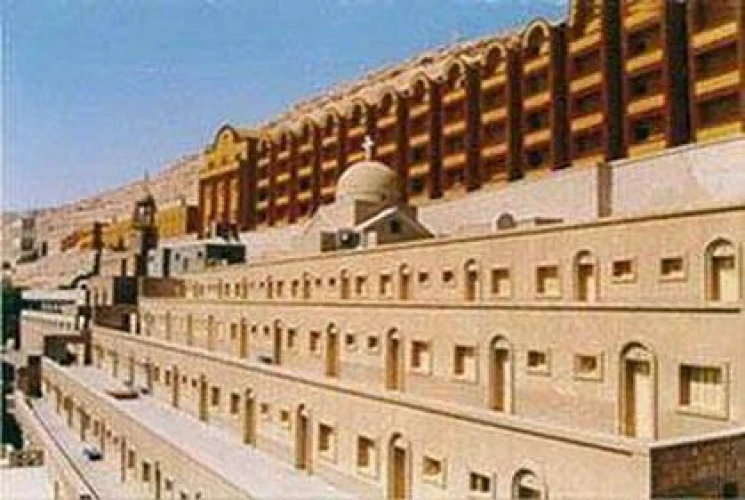
Prior to heading into the depths of Upper Egypt, the Holy Family passed through the western desert depression of Wadi El-Natrun (ancient Scetis), which was blessed by their presence and became the birthplace of ancient Christian monasticism. In the 4th century A.D., the region saw the birth of the Christian monastic traditions of this fertile valley. It is said to be the home of St. Macarius the Great and the Desert Fathers. Even today, the tradition of reclusive monastic life continues within the valley’s four active, walled monasteries.
Deir Anba Bishoy: Known for its large 5th century keep tower (hisn), drawbridge, secluded courtyards and the body of St. Bishoy.
Deir Al-Suryan (Monastery of the Syrians): Famous among art historians, Deir Al-Suryan is noted for the 8th century wall paintings, early Coptic-Syriac frescoes and the historic “Tree of Saint Ephrem.”
Deir Al-Baramus: A hidden monastery, known for its medieval fortifications, ancient chapels, and calm atmosphere.
Deir Abu Maqar (Monastery of St. Macarius): The home of Coptic theological studies, Deir Abu Maqar houses a large collection of historic manuscripts.
4. Upper Egypt: Mountain Shelters and the Longest Stay
The southern leg of the journey follows intoUpper Egypt, where white limestone cliffs meet green riverbanks. These were the lands of the longest stay of the Holy Family in Egypt.
Gabal El-Teir (Minya)
Nestled high in the cliffs near Samalut, the excavated rock-hewn Church of the Virgin Mary at Gabal El-Teir (Mountain of the Birds) was built in 328 AD by Empress Helena. The church surrounds the mountain cave, where the family made it their shelter. This place is also know as Kaff El-Adra (The Palm of Our Lady) – where tradition has it, the infant Jesus stretched out his hand to stop a rock from rolling down the mountain and hitting the boat.
Deir El-Muharraq (Mount Qosqam, Assiut)
Near El Qusia in Assiut lies Deir El-Muharraq, the most important stop on the whole journey. The Holy Family spent 6 months and 10 days in a simple mud-brick room here – the longest stay in any one place in all of Egypt. In the first century AD, this humble dwelling was turned into a chapel and is said to house one of the oldest Christian stone altars in existence. It was during their stay here that the Angel of the Lord appeared to Joseph the Carpenter in a dream, informing him that Herod was dead and telling him to return to Israel with the infant Jesus.
Mount Dronka
To the southwest of Assiut city lie the massive limestone caverns high in the cliffside at Mount Dronka, where the family took shelter from the seasonal floods of the Nile prior to their return journey north to Nazareth. Even today, the complex in the cliffside is the scene of major annual gatherings of pilgrims who arrive in August for the large feast.
Travel and Cultural Etiquette
The ideal time to visit Egypt is between October and April, when the temperatures are at their mildest. As the journey is mainly made on local roads, it is recommended to use private air-conditioned coaches or cars and a professional guide due to the challenging conditions of both the desert and the regional agricultural roads.
Modest dress covering shoulders and knees is advisable when visiting churches, crypts, and monasteries.





-webp.webp "Hilton")
-webp.webp "dusit")
-webp.webp "Marriott Hotels")
-webp.webp "Azimut Hotel")
-webp.webp "Golden Tulip")
-webp.webp "sheraton")
-webp.webp "westin hotel")
-webp.webp "Movenpick")
