
 English
 Italy
Italy
Holy Family Journey in Egypt: Sites, Churches and Monasteries
The Holy Family’s Pilgrimage Trail from Egypt: A Guide to Its Most Important Places, Churches, and Monasteries
The Holy Family’s journey through Egypt is one of the most spiritually stirring and historically significant pilgrimages. As described in the Gospel of Matthew, the Virgin Mary and St. Joseph fled Bethlehem with the young Christ to escape the wrath of King Herod. The family spent approximately 3.5 years in Egypt, covering more than 3,500 km through the Nile Delta, Old Cairo, Nitrian Desert, and Upper Egypt.
Today, the trail extends through 25 officially recognized sites linked by ancient rock-cut caves, holy water wells, hanging sanctuaries, and desert monasteries. Here’s a summary of the most important places, churches, and monasteries of this holy route.
Key Regions & Primary Holy Family Sites
The trails extend through four primary regions containing a wealth of local legends and relics:
A. The Nile Delta (The Northern Entry Points)
Tell Basta (Bubastis): The city where the Holy Family first entered the Delta. Legend holds that idols fell as Jesus entered the city, and a spring miraculously erupted to give him fresh water.
Sakha (Church of the Virgin Mary): This region is famous for the Bikha Isous stone, a large rock with an indentation said to contain the footprint of the infant Jesus.
Mustorod (Church of the Virgin Mary): Also known as Al-Mahamma (“the bathing place”), this is where the Virgin Mary bathed the baby Jesus in the local spring. This site is still a popular destination for Christian pilgrims and is known as one of the most important places on the trail.
B. Coptic Cairo (The Spiritual Heart of the Trail)
Church of Abu Serga (St. Sergius and Bacchus): Built over the crypt where the Holy Family spent several weeks.
The Hanging Church (Al-Muallaqa): Suspended above the remains of the Roman Fortress of Babylon, the 3rd-century church served as the center of the Coptic Orthodox faith.
Virgin Mary Church in Maadi: Located on the banks of the Nile, this is where the family supposedly boarded a sailboat for their journey down the river into Upper Egypt.
Virgin Mary’s Tree in Matariya: An ancient sycamore tree where the Virgin Mary rested while the infant Jesus created a spring that would nourish a balsam tree whose oil was used to consecrate Chrism.
C. Wadi El Natrun (The Nitrian Desert Monasteries)
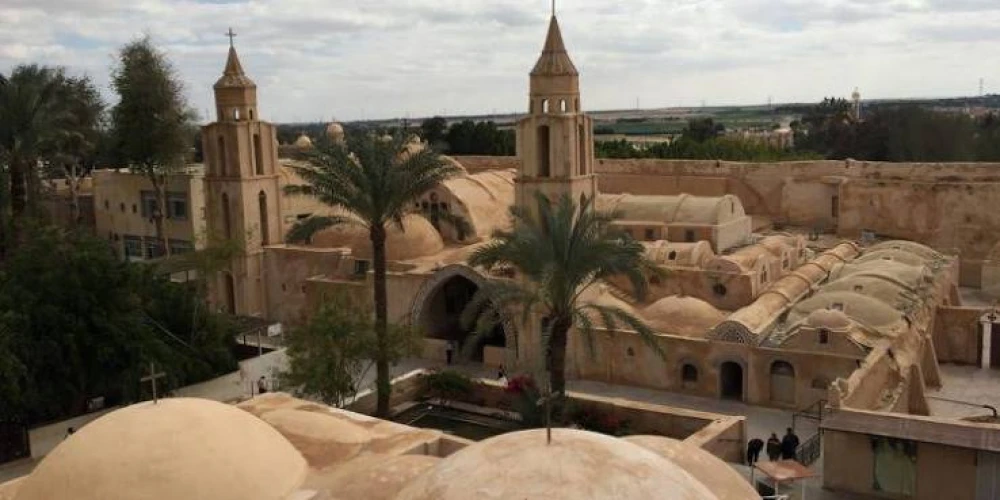
Approximately 100 km northwest of Cairo, this desert valley became the birthplace of early Christian monasticism in the 4th century AD. The monks built a series of fortified monasteries along the trails frequented by the Holy Family:
Monastery of Saint Bishoy (Deir Anba Bishoy): The remains of St. Bishoy and a holy well blessed by the infant Jesus can be found within the ancient complex.
Monastery of El-Suryan (The Syrian Monastery): Famous for its 8th-century Syriac frescoes, ancient library, and the “Tree of St. Ephrem”.
Monastery of El-Baramus: One of the oldest monasteries in the valley, this complex is notable for its ancient keeps and tranquil basilicas.
D. Middle & Upper Egypt (The Cliffside Shelters)
Gabal Al-Teir (Mountain of the Birds, Minya): A cliffside monastery complex built over a limestone cave where the Holy Family took shelter. According to legend, a falling rock was stopped by the infant Jesus, leaving an imprint of his hand on the rock.
Monastery of Al-Muharraq (Asyut): Located at the foot of Mount Qusqam, this is the most important southern site associated with the Holy Family. The family spent over six months in a cave nearby, which is now the altar within an ancient church complex. It is believed to be one of the oldest churches on earth.
Drunka Monastery (Asyut): Built into high limestone cliffs overlooking the Nile valley, this complex marks the furthest southern destination of the Holy Family before receiving the angels’ message that they should return home.
Practical Travel Protocol & Pilgrim Tips
Best Time to Visit: The most comfortable time to visit Egypt is between October and April, as summer temperatures can be extremely hot, particularly in the desert monasteries and cliffside sanctuaries of Upper Egypt.
Dress Code: Shoulders and knees must be covered at all churches and monasteries.
Travel Tips: While the sites of Coptic Cairo and Wadi El Natrun are easily accessible by road or metro, it is best to hire a professional tour guide or driver if visiting the Minya and Asyut regions.
Photography Policy: While most churches allow photography, it is best to avoid using flash in ancient crypts, behind screen altars, or when photographing holy relics.





-webp.webp "Hilton")
-webp.webp "dusit")
-webp.webp "Marriott Hotels")
-webp.webp "Azimut Hotel")
-webp.webp "Golden Tulip")
-webp.webp "sheraton")
-webp.webp "westin hotel")
-webp.webp "Movenpick")
