
 English
 Italy
Italy
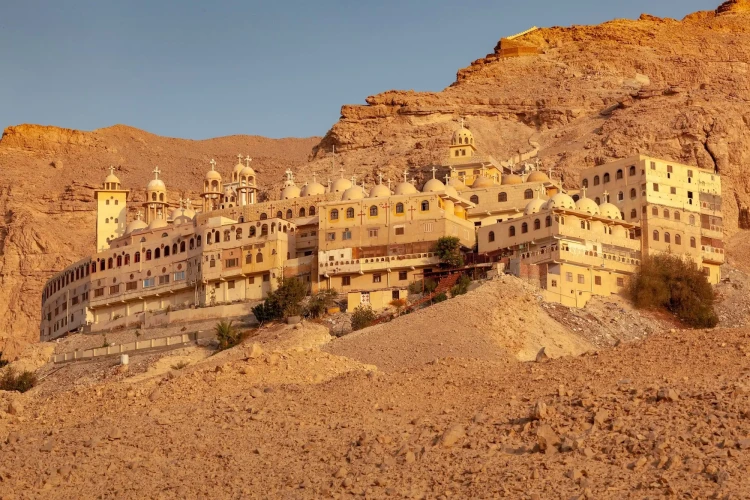
Guardians of the Desert: Egypt’s Most Historic Monasteries
Top Monasteries in Egypt Every History Lover Should Visit
When people think of Egypts history, their minds kinda just instantly jump to giant pyramids, golden pharaonic masks, and these towering sandstone temples sitting along the Nile. But there is also this other really captivating chapter, that tends to slip under the radar for mainstream travelers, its ancient Christian heritage.
Egypt actually played a big part in the early development of Christianity. And honestly, Christian monasticism, like the whole idea of stepping away from worldly life, to devote oneself fully to spiritual focus, was born in the deserts of Egypt during the 3rd and 4th centuries. St. Anthony of Egypt, who is widely seen as the father of Christian monasticism , inspired thousands of seekers to move into the harsh, almost silent wilderness, forming quiet settlements that later transformed into fortified desert monasteries.
If you are a history person, visiting these sacred places gives you a totally different view of Egypt. You will find them high in rugged mountain ranges, deep inside desert oases, or tucked away in older city quarters. And inside, these still-living communities preserve ancient manuscripts, impressive Byzantine frescoes , plus traditions that go back centuries.
Here is a loose guide to the top historic monasteries in Egypt, that every history buff should really add to their travel bucket list.
1. Saint Catherine’s Monastery: The World’s Oldest Continuously Inhabited Monastery
So, you’re standing at the foot of Mount Sinai, in that rugged southern kind of desert on the Sinai Peninsula, and there’s Saint Catherine’s Monastery. It’s arguably the most well known monastic complex anywhere, and also one of the most historically important. It was built between 548 and 565 CE, by order of the Byzantine Emperor Justinian I, and today it’s a UNESCO World Heritage Site. Also, it has been running—like actually operating without major interruption—for over 1,400 years, which is kind of unbelievable when you think about it.
Why history lovers might get genuinely amazed, you know, the usual reaction:
Unbroken continuity: because the place is far out there, and because there were protective decrees from past rulers, including Prophet Muhammad himself, Saint Catherine’s was never fully destroyed, or left behind. It just stayed.
Incredible sacred art: inside there is an astonishing collection of early Byzantine encaustic icons, meaning wax-based images, and these survived the 8th century Iconoclasm movement. That movement erased similar works across much of Europe, but not here, at least not in the same way.
The Sinai Codex legacy: and then, there’s the library. It holds thousands of rare old manuscripts in Greek, Syriac, Arabic, and Coptic, and honestly it ranks as the second most important historical library collection only after the Vatican Library.
2. Monastery of Saint Anthony: Where Monasticism Began
Deep in the Eastern Desert, half tucked against those red cliff faces near the Red Sea Mountains, you find the Monastery of Saint Anthony. It was founded around 356 CE by St. Anthony’s disciples not long after his death, and the whole complex feels like it’s sitting right on the very spot where desert monasticism first began, or at least that’s the story people keep repeating.
What makes it special , honestly, is the way everything feels layered, old, and still alive
The Ancient Church of St. Anthony: the historical core has that multi domed architecture and walls that were newly restored, with 13th-century Coptic frescoes now looking remarkably vibrant. You can see saints, angels, and biblical episodes, painted in a style that still holds its weight even today.
St. Anthony’s Cave: for travelers with energy, there’s a long climb—wooden stairs, step by step—pushing about 300 meters up the cliff above the monastery until you reach the natural cave. This is the place where St. Anthony lived as a hermit, in near complete solitude for more than 20 years. And when you finally pause, the panoramic views over the desert floor below are frankly breathtaking.
3. Monastery of Saint Paul the Anchorite: The Remote Hermit Sanctuary
Not far, like a quick drive over the mountains from St. Anthony’s, the Monastery of Saint Paul keeps its memory and prayer for St. Paul the Hermit. He slipped into the desert during Roman persecutions, and spent almost 90 years tucked in a natural cave. There’s a legend too, that a raven would bring him half a loaf of bread each day so he could keep going, you know to stay alive.
Some Historical Notes, kind of the big things people remember
The Cave Church of St. Paul: this sanctuary was built right over, and around, the underground cave where St. Paul stayed. Inside, the walls are lined with old Coptic murals, there are hanging silver lamps, and the marble tomb of the saint.
Fortified Survival Architecture: as with many desert monasteries, St. Paul’s has thick 5th-century defense walls. There’s also a drawbridge style entrance, plus tall watchtowers, made to shield the monks from bedouin raids in those ancient days.
4. The Monasteries of Wadi El Natrun: The Desert Valley of Faith
Somewhere about halfway between Cairo and Alexandria, Wadi El Natrun (also called the Natron Valley) used to host dozens of thriving monastic communities, around the 4th and 5th centuries, give or take. Nowadays , only four historic, fortified active monasteries are still standing and they function as real spiritual hubs for the Coptic Orthodox Church
Across the valley, a few highlights stand out, and they do feel different from one place to another
Deir Al-Surian (Monastery of the Syrians) : This one is well known for the striking 10th-century Church of the Virgin Mary, it includes rare Syriac wall paintings, plus those intricate ivory-inlaid wooden doors, and there’s also an old style library tower
Deir Amba Bishoy: It takes its name from St. Bishoy, whose body is said to stay incorrupt and preserved inside the main church. The place remains active, so it feels like a calm sanctuary , with palm gardens, ancient fort like keeps and traditional vaulted ceilings.
5. The Hanging Church & St. Sergius: Urban Monastic Roots in Old Cairo
Even if they’re not some kind of isolated desert monasteries in the old, classic sense, no real exploration of Egypt’s Christian legacy is really finished without stepping into the historic religious complexes tucked away inside Coptic Cairo.
Must-Visit Landmarks:
The Hanging Church (Al-Muallaqah) : It was built directly on top of the gatehouses of the ancient Roman Fortress of Babylon, and the nave, well it hangs suspended above the ancient stone passages below. Inside, you’ll see an exquisite timber roof, shaped like Noah’s Ark, plus those careful ebony-and-ivory screen altars, almost like a quiet watchfulness.
Church of St. Sergius and Bacchus (Abu Serga) : Dating back to the 4th century, this revered place rests over the crypt where the Holy Family (Jesus, Mary, and Joseph) is traditionally said to have sheltered, for about three weeks while fleeing into Egypt.
Practical Tips for Visiting Egypt's Monasteries
Respect the Dress Code: monasteries are real places of worship ,and also daily work. When you come as a visitor try to dress modestly, cover the shoulders , the chest and also the knees, it’s pretty important
Mind the Visiting Hours: in desert monasteries they sometimes change opening times based on fasting seasons, like Lent, or around daily prayer moments. So, before you plan any long drive, make sure the site is actually accessible
Think about Travel Distances: places like St. Anthony and St. Paul are best done as a long day journey from Cairo or Hurghada. But Saint Catherine, well that one usually calls for staying overnight in Sinai





-webp.webp "Hilton")
-webp.webp "dusit")
-webp.webp "Marriott Hotels")
-webp.webp "Azimut Hotel")
-webp.webp "Golden Tulip")
-webp.webp "sheraton")
-webp.webp "westin hotel")
-webp.webp "Movenpick")