
 English
 Italy
Italy
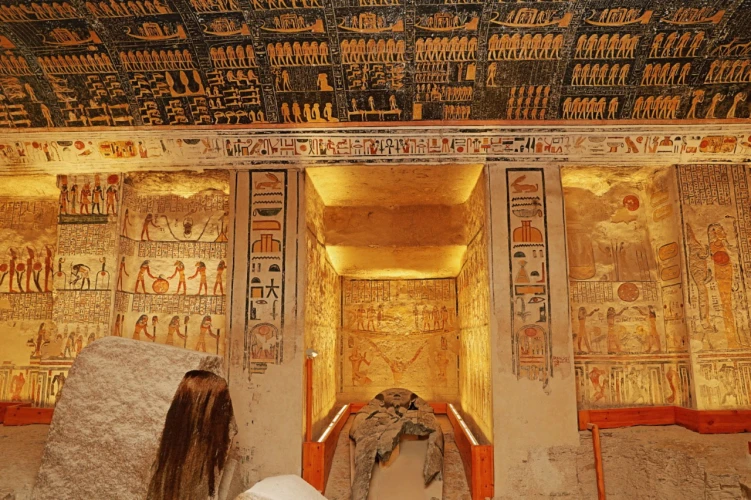
Gateway to the Afterlife: Inside the Subterranean Palaces of Ancient Thebes
The Valley of the Kings: The Eternal Resting Place of the Pharaohs
Deep within the arid limestone hills, in the Theban Necropolis on the west bank of the Nile, across from modern-day Luxor, there sits one of the most famous archaeological places on Earth: The Valley of the Kings, (Wadi el-Muluk). In ancient times it was called the Great and Majestic Necropolis of the Millions of Years of the Pharaoh, Life, Strength, Health Above The West of Thebes, and it’s kind of tucked away—an isolated desert canyon that somehow became the main resting ground for Egypt’s royal rulers, also for important elite nobles, across the New Kingdom, roughly 1550–1069 BC.
For almost five centuries, stretching through the 18th, 19th, and 20th Dynasties, pharaohs like Tutankhamun, Hatshepsut, Seti I and Ramesses the Great were laid into these deep subterranean rock-cut rooms. The interiors were packed with things you can’t really picture, like priceless treasures, complex funerary writings, and bright, cosmic-style art . And the whole design, in a sense, worked as a kind of magical passage, meant to guide the divine kings through what comes after, so they could secure an eternal renewal, or at least that’s the idea.
So this is the complete story of the Valley of the Kings—its sacred layout, its secret tomb architecture, its hidden written spells, and the legacy that still feels immortal today.
1. Why the Valley? Sacred Geography and Natural Pyramids
Before the New Kingdom started, the pharaohs from the Old and Middle Kingdoms built these huge, stone pyramids in northern Egypt to keep their royal remains. Yet, honestly, those giant monuments became like literal guiding lights for ancient tomb robbers so widespread looting and desecration followed, again and again.
Then, when the kings of the New Kingdom set up their imperial capital in Thebes, they shifted to a different burial mindset, more like secrecy mixed with something natural, kind of integrated.
The Natural Pyramid (Al-Qurn)
They picked the place for two deep, very specific reasons,
The Natural Pyramid: Right above the valley there is this tall pyramid-shaped rock formation that still stands today, known as Al-Qurn (“The Horn”), and in ancient times it was called Dehent. Instead of hauling stone to make a pyramid, the rulers basically borrowed the sacred pyramid symbolism from the mountain itself.
Isolation and Protection: The canyon could be reached only by narrow mountain routes that were easy to control and defend. It was also hemmed in by harsh sun-baked ground, and this landscape was linked with the goddess Meresger (“She Who Loves Silence”). She was the cobra deity, the one said to guard the necropolis.
Also, they kept the tomb separate from the public mortuary temple, those temples were built miles away near the Nile floodplain. That distance, and the layout, helped hide the exact burial sites from thieves, more or less.
2. Subterranean Architecture: Engineering an Underworld
The tombs in the Valley of the Kings are basically masterpieces of rock-cut engineering, carved right into the core of limestone mountains by elite royal artisans, who actually lived in the nearby village of Deir el-Medina.
You can see the changes over time, kind of like the style just kept shifting. Over five centuries, the architectural layouts evolved
Early on, The Bent Axis (18th Dynasty): tombs like the ones for Thutmose III and Hatshepsut had steep descending passages that sort of dropped down, then turned hard at right angles before the burial space. The idea was to imitate the winding routes of the underworld, and also discourage intruders.
Later, The Straight Axis (19th & 20th Dynasties): tombs that include those of Seti I and Ramesses VI were cut as a long, steady straight route going for hundreds of feet straight into the mountain, almost like a direct route rather than a maze. This was meant to represent the sun god Ra moving straight through the darkness.
Then there are the key “body parts” of a typical royal tomb, or you could call them functional zones in a set sequence
Descending Corridors: these stand for the move from the bright world into the shadowy realm associated with Osiris.
The Well Shaft: a deep pit cut into the floor. It had a practical job (capturing flash-flood waters) but also a spiritual role, a symbolic entry into a watery abyss.
The Pillared Hall: this part was held up by heavy limestone pillars, and the pillars were carved with reliefs showing the pharaoh being received or welcomed by different deities.
The Golden Burial Chamber (House of Gold): the main vault where the heavy stone sarcophagus sat, along with multi-layered wooden coffins, and the king’s mummified body.
3. The Guidebooks to the Afterlife: Sacred Funerary Texts
The walls of the royal tombs were not for show, not as those decorative gallery things for the living; they were more like useful enchanted roadmaps , painted in vivid reds, blues, yellows and blacks , to steer the king’s spirit (Ba) through the nasty traps of the underworld (Duat).
Along those corridors, key sacred writings are carved and painted—like they always are—somewhat in rows, somewhat in spirals, and kind of everywhere. The most well-known ones include
The Amduat ( “That Which Is in the Underworld” ): it lays out the 12 hour night voyage of the sun god Ra inside the cavern like depths of the world, where he fights the disorderly serpent Apophis, until he’s “renewed” again near dawn.
The Book of Gates: close in spirit to the Amduat, it talks about the twelve guarded gates the pharaoh has to pass , and by offering the hidden names of the divine guardians, he gets allowed through.
The Book of the Heavenly Cow : this one recounts the tale of people’s rebellion , plus how the cosmos gets reorganized, like the sky is reshaped from the inside.
The Litany of Ra : a heavy theological hymn, praising the 75 separate names and appearances of the sun god, in a way that feels both careful and loud, depending on who is reading it.





-webp.webp "Hilton")
-webp.webp "dusit")
-webp.webp "Marriott Hotels")
-webp.webp "Azimut Hotel")
-webp.webp "Golden Tulip")
-webp.webp "sheraton")
-webp.webp "westin hotel")
-webp.webp "Movenpick")
