
 English
 Italy
Italy
From the Delta Marshes to the Throne: The Myth and Power of Horus
Horus: The Sky God, Divine Avenger, and Lord of Pharaonic Sovereignty
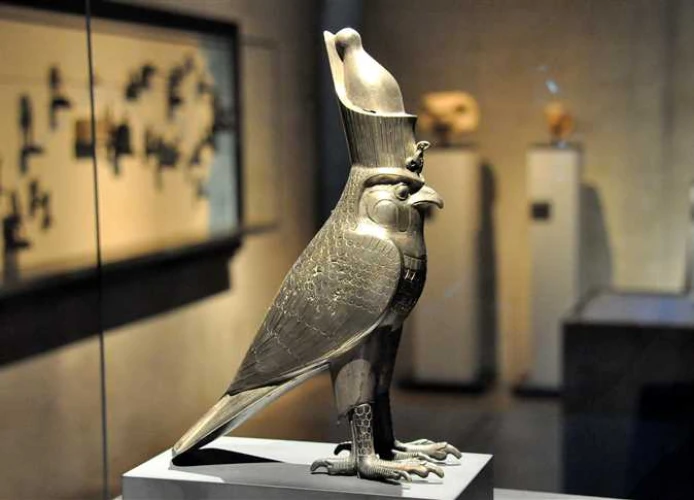
Throughout the long , and storied history of ancient Egypt , it seems like no single deity matched Horus for royal legitimacy and this whole cosmic win thing. The ancients knew him as Heru (kinda meaning “The Distant One” or “The High One”), but Horus wasn’t just some tough sky god drifting above the Nile Valley. No, he becomes something else entirely , like the ultimate guardian of the realm, the divine fighter who defeats disorder, and also the celestial parent of every reigning pharaoh.
From the early start of the Early Dynastic Period , all the way to the last days of the Greco-Roman Era, the falcon headed figure stayed right in the center of Egyptian statecraft, military thinking, and devotional life in general.
This is the full account of Horus—his unusual birth, his big struggle with Seth, the famous sacred emblems , and how he shapes what pharaonic kingship is supposed to mean.
1. The Miraculous Birth in the Papyrus Marshes
The story of Horus is so tied up with the famous Osiris myth, it’s basically one of those central big things in ancient Egyptian religion, like the main epic everyone keeps talking about.
After Osiris was murdered in a cruel way, then cut apart by his jealous brother, Seth, the goddess Isis did what she could with her powerful sorcery. She managed to bring Osiris back, at least for a moment, long enough for a kind of impossible union. From that, Isis conceived Horus , but it was done quietly, in secret.
The not so easy child of Chemmis
To keep her unborn son safe from Seths violent rage, Isis ran to the swampy reed lands of Chemmis, in the Nile Delta. In hiding there, she gave birth to Horus, and of course it wasn’t like a calm little story.
Life around the Delta: when he was still an infant, they called him Horus the Child, or sometimes Harpocrates, he was easily harmed by scorpion stings, venomous snake bites, wild animals, and illnesses too.
A mother that wouldn’t let go: Isis, with those magical spells, kept guiding and mending him, and Thoth, the wise one, also helped him. So Horus kept surviving each danger, getting stronger , more stubborn, until he finally felt ready to take back what was rightfully his.
In the end this early struggle of Horus turned into a kind of everyday sign, not only for kings or temples but for people. It became a symbol of resilience, of healing, and also of protection for children, in those simple lives in Egypt.
2. The Contendings of Horus and Seth: Order vs. Chaos
When Horus reached adulthood, he stepped forward kind of, to challenge his uncle Seth before the divine council of gods , the Ennead, insisting he had the rightful claim to the throne of Egypt. And then well, what happened next was this dramatic, multi decade struggle, often called The Contendings of Horus and Seth.
Honestly it wasn’t just a messy family argument either, it was more like a cosmic clash, between two opposite underlying powers that don’t really meet in the middle:
Horus , stood for Ma'at order and justice, civilization and the life giving, fertile stretch of the Nile Valley.
Seth , stood for Isfet, chaos, violence, the untamed foreign wilderness, and that harsh scorching desert heat.
The Epic Battles and Testings stuff
There were physical showdowns, divine courtroom moments, plus sly trials arranged by the gods:
The Hippopotamus Contest: In one well known trial, both gods turned into hippopotamuses , then sank into the Nile, trying to see who could stay under water for three years without popping up.
The Wounding: During these brutal battles , Seth ripped out Horus’s left eye, and in return Horus cut off Seth’s testicles, which is taken as a symbol of removing Seth’s chaotic creative energy.
The Divine Verdict: After eighty years of stuckness, stalemate plus a lot of legal talk, Isis’s insight and Osiris’s authority ended up winning. The council of gods granted Horus the crown of Egypt, and they banished Seth to the outer desert boundary.
Horus then took up the divine title Horus Avenger of His Father , Heru-nedj-itef, and this set a kind of smooth line of royal succession, supposedly harmonious and all.
3. The Living Pharaoh: The Earthly Embodiment of Horus
The win,of Horus kind of set the main ideological spine of ancient Egyptian rule: the sacred ,almost biological divine nature of the pharaoh.
Every reigning king of Egypt was seen as a earth-bound presence and also a living container, for Horus. When a pharaoh took the throne, he didn’t just “start ruling” he assumed the Horus Name— the oldest and arguably the most vital of the five official royal titles, used by Egyptian monarchs.
The Living King ,(Horus): while the pharaoh was still alive, he was the living Horus, expected to guard the boundaries keep Ma'at steady, and generally keep the cosmic balance from slipping.
The Deceased King ,(Osiris): after death the pharaoh would join with Osiris to govern the afterlife, and his son, as the next ruler, became the new living Horus here on Earth.
All of that ongoing loop meant political stability that felt unbroken, along with religious continuity, across roughly three thousand years of Egyptian dynasties.





-webp.webp "Hilton")
-webp.webp "dusit")
-webp.webp "Marriott Hotels")
-webp.webp "Azimut Hotel")
-webp.webp "Golden Tulip")
-webp.webp "sheraton")
-webp.webp "westin hotel")
-webp.webp "Movenpick")
