
 English
 Italy
Italy
From Temple Ruins to Golden Skies: A Photographer's Guide to Luxor Ballooning
From Temple Ruins to Golden Skies: A Photographer's Guide to Luxor Ballooning
There is something special about the particular kind of anticipation of packing up the camera equipment for an early morning shoot. You look through your memory cards, double-clean your lenses and wonder whether you will be able to do justice to the sights you are going to witness through your lens.
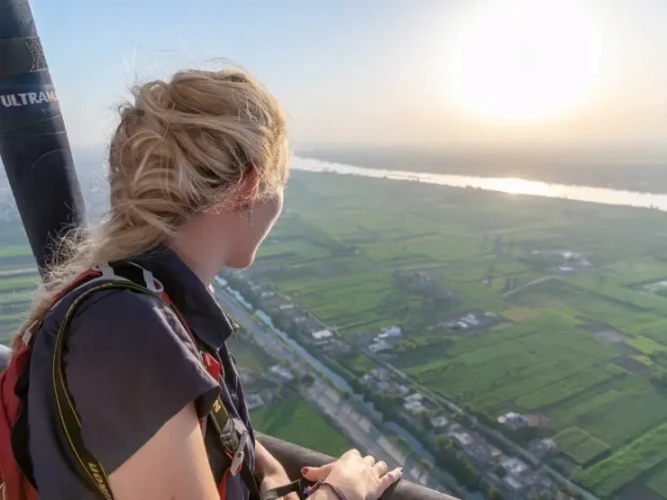
Imagine that you want to photograph one of the most historically-rich spots in the world from the basket of a hot air balloon floating a thousand feet high above the ground and bathed in the light of a rising sun in gold, pink and deep amber hues.
Luxor is widely referred to as the open-air museum of the whole world. From the perspective of photography, it can be considered as a photographer's paradise. But shooting from a moving, floating basket takes a bit of a different approach than shooting from solid ground.
In case you are planning to use your camera, phone or even drone during your balloon ride over Luxor, let's go through a step-by-step guide to taking perfect pictures.
Part 1: Packing Your Gear Without Overcomplicating It
When you are in a dark and busy launch field at 5:00 AM with the noise of burners around you, you do not need to look for your camera in a big backpack with lots of heavy lenses and accessories. Be practical and pack smart.
Go-To Lens Combination: If you have a mirrorless or DSLR camera, a good 24-70mm is your best companion in any case. The versatility of a zoom lens allows you to take wide-angle shots of the Nile River as well as zoom in closer to see the architecture of the balloon from above. If you wish to capture compressed images of hot air balloons hovering close to one another, then the 70-200mm lens will be perfect for you—but remember, the space in the basket is limited.
Remember to Use a Polarizing Filter: In the mornings, there tends to be atmospheric haze in the desert air. A circular polarizer would come in handy since it eliminates the glare, adds contrast to the pale yellow sand and blue sky.
Use a Wrist Strap for Your Camera/Phone at All Costs: This should go without saying but it’s one of the most important rules. You do not want to lean over the edge of the basket while holding the camera or phone in your hands because one gust of wind or bump could mean dropping the device one thousand feet down.
Part 2: Mastering the Light and the Shutter Speed
Luxor balloon magic is entirely dependent on the sun. There isn't much time for shooting during the period of gorgeous lighting, so knowing how to set the exposure before taking off would be a good idea.
Keep Shutter Speed High: One may think that since the hot air balloon is stable and steady, shutter speed doesn't have to be very high. Yet it always moves, rotates slowly in the wind and shifts a bit. In order not to get blurred pictures, set shutter speed to 1/500s and higher.
Shoot During the Golden Hour: Get a hot air balloon during the first flight of the day. There will be long and spectacular shadows of the limestone cliffs on the West Bank, the Colossi of Memnon and ruins of ancient mortuary temples.
Be Careful with Your Exposure Settings: The bright sky early in the morning tends to fool your camera's light metering system, causing underexposure of the dark ground underneath. If possible, shoot in RAW or use exposure compensation in order to preserve all details of ancient temples and green fields of earth, and not just shadows.
Part 3: Composition Tricks for That "National Geographic" Look
Almost everyone can direct their camera downward and take a picture of the ground below. However, if you want your travel photos to be special, follow these basic composition rules as you fly above:
1. Use Foreground
By far, the most common mistake made when taking aerial photographs is creating an image of a vast empty space. Instead, try including some element such as the rim of your wicker basket, a thick rope, or bright nylon material of a neighboring hot air balloon in one of the corners of your photograph.
2. Looking Down and Looking Around
It is very tempting to lose yourself in the view of the far horizon as the sun rises into the sky. However, do not forget to look directly below you. Some of the most beautiful, human shots that you will capture will be made while the plane slowly descends over the West Bank. Find small farmers working their way through sugar cane plantations, little mud brick houses with drying laundry on their rooftops, and irrigation channels shining in the early morning sun as silver strands.
3. Capturing the Proportions of History
When looking down upon the huge columns of the Ramesseum or Queen Hatshepsut’s temple from above, one cannot but realize how minuscule human constructions become compared to the vast expanses of the desert. Use wide shots to demonstrate how the ancient monuments were consciously constructed in the shadow of the mountains.
Part 4: Practical Safety Rules for Photographers
But how about some logistics? Tense photographer is not a good photographer, hence here are some simple tips that will help you to have a trouble-free morning:
Use a Cross-Body Bag Instead of a Backpack: When squeezed in the same compartment as other people, changing a lens from the backpack becomes an impossible task. Instead, use a small belt pack or a cross-body sling bag, where your equipment will be always in front of you and easily reachable.
Charge Your Devices Completely in Advance: Desert cold at the early morning hours negatively affects camera battery charge. Batteries discharge very fast under low temperatures. Therefore, make sure that all your devices are charged up to 100 percent in advance, and also carry an additional battery warmed up in your coat pocket.
Stay Present in the Moment (Only a Little Bit): It is really easy to look through your viewfinder or smartphone screen for the whole 50-minute flight. Don’t forget to rest a little bit during this time and enjoy fresh morning air and roaring sound of a burner.
Final Thoughts: The Shots You’ll Treasure Forever
Photography is about preserving a moment—a certain moment that one will always remember.
In years to come, when one goes through the photos that one took in Luxor, one will not simply be reminiscing about the ruins and the sunsets. One will vividly remember the feeling of that pre-dawn chill, the fire roaring in the sky above, the serene awakening of the desert, and the pure excitement of being suspended in the clouds.
Bring your camera, lock your wrist strap, and prepare yourself to record an experience that will stay with you for the rest of your life.





-webp.webp "Hilton")
-webp.webp "dusit")
-webp.webp "Marriott Hotels")
-webp.webp "Azimut Hotel")
-webp.webp "Golden Tulip")
-webp.webp "sheraton")
-webp.webp "westin hotel")
-webp.webp "Movenpick")
