
 English
 Italy
Italy
From Mentuhotep to the Royal Cache: The Untold History of Deir el-Bahari
Deir el-Bahari: The Sacred Valley of Royal Temples and Hidden Pharaohs
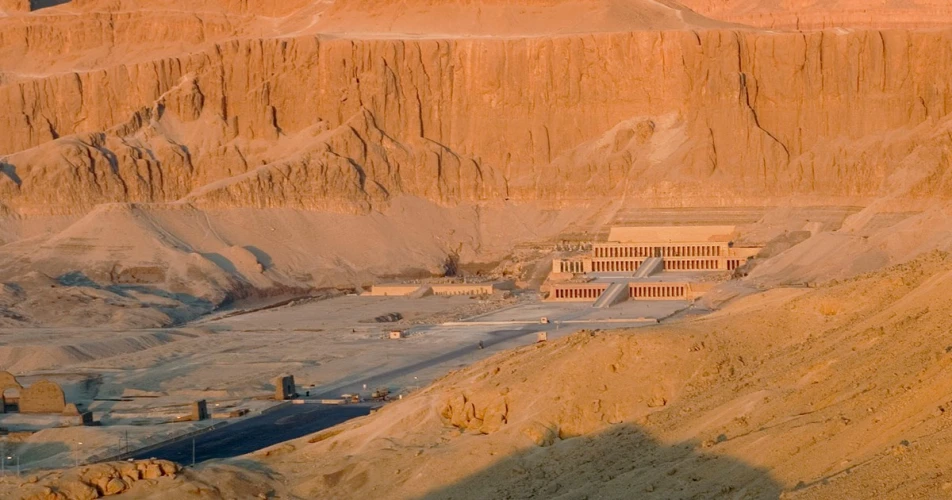
Tucked up against the sheer, towering limestone cliffs of the Theban Necropolis on the west bank of the Nile, in Luxor , Deir el-Bahari feels like one of those places that is both breathtaking and packed with history at the same time. It’s a visually stunning patch of landscape, and honestly one of the more historically dense archæological zones you’ll ever see in the whole world. The Arabic name loosely becomes “The Northern Monastery,” and it points to a Coptic Christian monastery that sat above the old remains, during the 7th century AD , or at least that’s what the records suggest.
Still, far earlier than any monastery, this kind of natural amphitheater with glowing golden rock was known by the ancient Egyptians as Djeser-Djeseru, basically a sacred threshold, where the living’s world meets those quieter mysteries of the afterlife.
Deir el-Bahari is well known, not only for its stepped , terraced temple complexes made by pharaohs from the Middle Kingdom and also the New Kingdom, but it also plays the stage for one of the biggest archæological finds in human history: the Royal Cache, the hidden deposit that kept Egypt’s most legendary rulers from being erased into nothing, eternal oblivion, you could say.
So here’s the full account of Deir el-Bahari—its sacred terrain, its grand royal monuments, and that secret function it had in guarding pharaonic memory, even when time tried to undo it.
1. The Sacred Amphitheater: A Landscape for the Gods
The strange geography of Deir el-Bahari seemed to help, a lot, in the choice of it as a royal burial place. Basically the natural bay, between towering limestone cliffs, makes a sort of horseshoe shaped valley, facing straight across from the grand Karnak Temple complex on the east side of the Nile.
Dedicated to the Goddess of the West
This valley was tightly connected with Hathor, the cow goddess, known for beauty, maternal attention, music, and the sky. She was also called “Lady of the Western Mountain,” and people thought she lived inside the limestone cliffs at Deir el-Bahari.
Ancient Egyptians imagined her coming up from the dark splits and gaps in the rocks at sunset, to greet the souls of dead pharaohs and noble figures, into the underworld, and to provide them cool water, sacred bread and lasting safeguarding.
2. The Pioneer Builder: Mentuhotep II and the Middle Kingdom
While most visitors tie Deir el-Bahari mostly to Queen Hatshepsut, the real layout pioneer in that valley was Pharaoh Mentuhotep II, from the 11th Dynasty (c. 2055–2004 BC).
And yeah, it’s kind of ironic, because Hatshepsut often gets all the attention. But Mentuhotep II is the one who really changed the game early on, ending the general mess that came with the First Intermediate Period, and then steering the kingdom back into one piece, Upper Egypt and Lower Egypt together again, basically launching the Middle Kingdom.
He is often called the Reunifier of Egypt, and after his success he wanted a place that felt permanent, so he selected the quiet, clean bay of Deir el-Bahari for his huge funerary complex, meant to keep his name alive, even after everything else fades.
What he built was not just “another temple,” it felt revolutionary for its time. For example, the whole thing used a terraced design on a raised platform carved straight into the desert ground, with broad porticos, colonnades, and a central mound-structure, kind of like a pyramid in spirit even if it isn’t exactly the same.
Then there’s the way you approach it, there’s a tree-lined processional idea, sort of, but instead of trees it’s more like a long walled causeway running from the lush floodplain up to the courtyard, and along the route there are dozens of painted sandstone statues of the king, wearing the Red Crown of Lower Egypt and the White Crown of Upper Egypt at once, or at least in that combined royal symbolism.
Also important, the tomb itself goes inward, deep under the rear courtyard there’s a rock-cut burial space, with a long sloping corridor dropping hundreds of feet down into solid limestone, all the way toward the king’s burial chamber.
So even if later rulers copied parts of it, Mentuhotep’s terraced concept was basically a direct blueprint, and royal architects picked it up again many years afterward, for their own big, official monuments.
3. The New Kingdom Golden Age: Hatshepsut and Thutmose III
Five centuries after Mentuhotep II, the valley sort of had this brilliant revival, uh, during the 18th Dynasty, when Pharaoh Hatshepsut chose the space right next to Mentuhotep’s monument to make her big masterwork.
Hatshepsut’s Masterpiece (Djeser-Djeseru)
Built by her chief architect Senenmut, Hatshepsut’s mortuary temple took Mentuhotep’s terraced idea and turned it into this three tiered geometric wonder, not exactly subtle, but very tidy:
Natural Integration: the temple’s neat, steady colonnades almost mimic the vertical bands of the limestone cliffs, which loom behind it.
Vivid Reliefs: on the middle terrace you get very detailed carved scenes, showing her “divine conception,” as the daughter of Amun-Ra, plus her well known trading journey toward the far-off land of Punt.
Sacred Shrines: along the sides sit chapels honoring Hathor, and also Anubis, they’re packed with preserved pigment colors, and Hathoric columns, like they’re meant to stay alive.
The Temple of Thutmose III
Right between the temples of Mentuhotep II and Hatshepsut was a smaller complex, less famous, that was put up by Thutmose III. He was Hatshepsut’s stepson, and later successor. Devoted to Amun-Ra, the temple called Djeser-Akhet (meaning “Holy Horizon”) was built near the end of his reign, up on a higher terrace overlooking the valley. It includes a striking bark shrine and delicate relief carvings, everywhere, as if the whole place was holding its breath.





-webp.webp "Hilton")
-webp.webp "dusit")
-webp.webp "Marriott Hotels")
-webp.webp "Azimut Hotel")
-webp.webp "Golden Tulip")
-webp.webp "sheraton")
-webp.webp "westin hotel")
-webp.webp "Movenpick")
