
 English
 Italy
Italy
From 60 AD to Today: The Story of the Historic See of Saint Mark in Alexandria
Saint Mark's Coptic Orthodox Cathedral in Alexandria: History, Sacred Relics & Spiritual Heritage
In the middle of downtown Alexandria, somewhere between those lively avenues of Ramleh Station, there is one of the most sacred places in Christian history : Saint Mark's Coptic Orthodox Cathedral (El-Morkosya). It sits, more or less on the same ground where Saint Mark the Evangelist, founded the first Christian church in Africa in the 1st century AD. So, this cathedral becomes the historical residence and spiritual anchor for the Coptic Orthodox Church of Alexandria , in a very direct way.
For almost two thousand years now, this holy sanctuary has seen the growth of North African Christianity, endured rough historical tremors, and kept—without interruption—the heritage tied to the See of Saint Mark. It is not only a worship space, more like a living emblem of Coptic identity , faith , and stubborn endurance.
Below you will find the full story, the architectural path, and the ongoing spiritual legacy of Saint Mark’s Cathedral in Alexandria.
1. The Dawn of Christianity in Egypt: Saint Mark’s Mission
The story of the cathedral is basically inseparable from the coming of Saint Mark the Evangelist , one of the four Gospel writers and a very close disciple of the Apostles as well.
Around 60 AD, Saint Mark came into Alexandria, a loud Greco-Roman metropolis and intellectual hub of the ancient world. As church history goes , when he first set foot in the city , Saint Mark’s sandal strap broke , kind of at the worst time. He brought it to a local cobbler named Anianus. While Anianus was repairing the sandal , he pierced his own hand with an awl , then he shouted in pain, and called on the “One God” ( you know, like saying it out loud without thinking). Saint Mark then healed Anianus’s hand, in the name of Jesus Christ, and he started to proclaim the Gospel to him, plus to everyone in his household too.
Anianus ended up becoming the first convert to Christianity in Alexandria, later he was ordained as the city’s second bishop. As the Christian community grew, a proper house for worship was set up near the sea, in a district called Bucalis. This rather plain coastal sanctuary was, in a way , the early predecessor of Saint Mark’s Cathedral, and that’s one reason Alexandria became the home , and the seat, of the oldest continuously living Christian community in Africa.
2. Martyrdom and Early Foundations
Saint Mark success in converting locals to Christianity, kind of alarmed the pagan population of Alexandria, it was like a real trouble for them. In 68 AD, during the feast of the Serapis festival a hostile mob seized Saint Mark while he was celebrating the liturgy at the church in Bucalis.
Then they dragged him through the stony streets of Alexandria, until his death, without any mercy. The faithful gathered his holy body and buried him in a crypt under the sanctuary that he had built, in a quiet place. For centuries this burial site became the holy shrine around which the faithful gathered, and in the end, the church turned into the physical and spiritual center of the Coptic patriarchs.
3. Two Millennia of Destruction and Resilience
Over its two thousand-year history Saint Mark's Cathedral has been rebuilt, restored, and expanded more than once it seems after times of war and messy natural disasters, plus political changes that just wouldn’t wait.
Early centuries: the first church structure was enlarged into a rather grand basilica as Christianity became the prevailing faith in Egypt during the 4th century, yes.
Invasions and ruin: during the Persian invasion and also later clashes around the Arab conquest of Egypt in the 7th century, parts of the church took serious damage. Still, Coptic Popes kept going, constantly restoring the place so the heart of the Patriarchate would stay active and not simply fade away.
A 19th-century rebuild: in the early 1800s, while Mohammed Ali Pasha was reigning, the Coptic community got permission to rebuild the whole cathedral complex. Then in 1870, the cathedral was reconstructed in a grand neo-Coptic architectural language, with double bell towers and big marble interiors that feel almost endless.
20th-century expansions: in the mid 1900s under Pope Cyril VI and Pope Shenouda III, the cathedral underwent more renovation and expansion to host thousands of pilgrims, but they did it while keeping its historic crypts and older altars, pretty carefully.
4. The Sacred Relics: The Journey of Saint Mark's Body
The cathedral kind of keeps an extraordinary history, about the physical relics of its patron saint, in a way that feels almost too dense to be true.
Back in 828 AD, Venetian merchants smuggled the main body of Saint Mark out of Alexandria and brought it to Venice, Italy, where they built the famous St. Mark's Basilica just to hold it. Still, Coptic tradition says the head of Saint Mark was left safely hidden in Alexandria, inside the cathedral crypt, guarded by the Coptic patriarchs through years of turbulence and sharp turns in events.
Then there was this really momentous thing in June 1968, when Pope Cyril VI negotiated, with the Catholic Church , for the return of a portion of Saint Mark’s relics from Rome back to Egypt. When the relics arrived, people received them with massive national celebration. And even now, while some part is housed in the modern Saint Mark’s Cathedral in Cairo, there is also a major relic shrine sitting inside the historic crypt of the cathedral in Alexandria, next to the head of the saint, plus the remains of dozens of ancient Alexandrian Popes.
5. Architectural Highlights and Sacred Treasures
The current structure of Saint Mark's Cathedral blends, some historical reverence with imposing sacred architecture in a way that feels almost too present, even today.
The Facade and bell towers
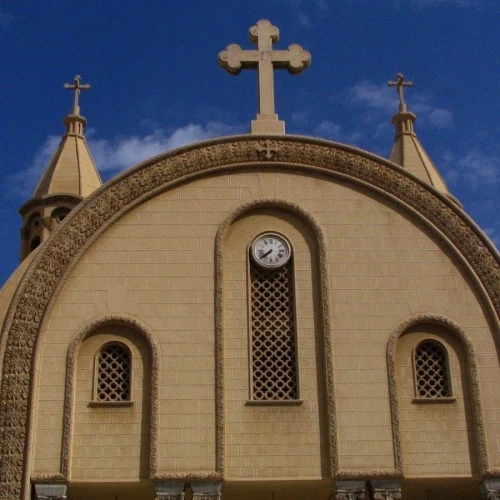
The cathedral’s exterior has this grand, white stone façade flanked by two square bell towers that rise above downtown Alexandria. There are intricate stone-carved crosses, and traditional arches around the main entrance, reflecting those traditional Coptic motifs, you know like it’s all meant to be recognized at first glance.
The great nave and iconostasis
Inside, the vast central nave is bordered by grand marble columns that hold up lofty arched ceilings. The main sanctuary is separated by a towering wooden iconostasis (icon screen) , meticulously hand-carved and carefully inlaid with mother-of-pearl. You can find historic icons here, showing the Life of Christ, the Virgin Mary, Saint Mark, and the Twelve Apostles, arranged like a quiet timeline.
The patriarchal throne
Within the cathedral there’s the historical Throne of Saint Mark, the symbolic seat of the Coptic Pope. Even though the primary residence of the Coptic Pope moved to Cairo in the 11th century because of political changes, Alexandria still stays the official historical See. So every Coptic Patriarch is crowned as the Pope of Alexandria and Patriarch of the See of Saint Mark. It sounds formal, but it also feels personal, somehow.
The ancient crypt
Under the main altar lies the subterranean crypt. Visitors can descend into this quiet, stone-walled chamber to view the shrine of Saint Mark, and also tombs holding the historic remains of early Patriarchs who led the Church through its most critical centuries.





-webp.webp "Hilton")
-webp.webp "dusit")
-webp.webp "Marriott Hotels")
-webp.webp "Azimut Hotel")
-webp.webp "Golden Tulip")
-webp.webp "sheraton")
-webp.webp "westin hotel")
-webp.webp "Movenpick")
