
 English
 Italy
Italy
Egypt’s Hidden Roman Ghost Town: Inside Qasr al-Labakha
Sentinel of the Sands: The Forgotten Legacy of Qasr al-Labakha
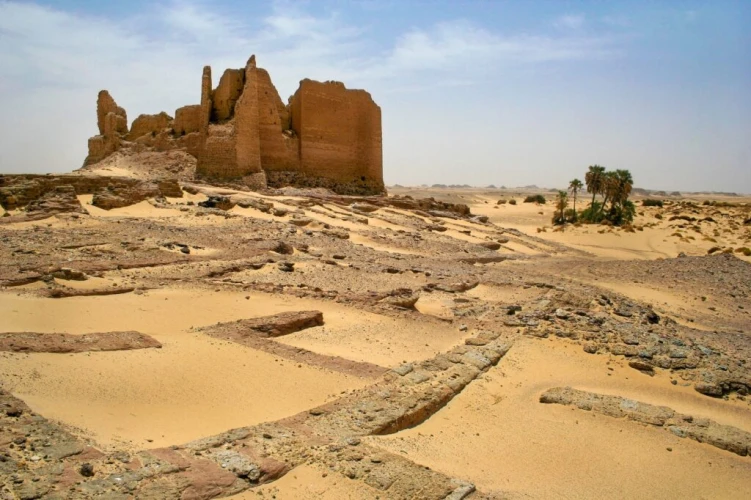
If you step away from the crowded, lively streets of the Nile Valley and push far into the huge, quiet stretches of Egypt’s Western Desert, the scenery kind of flips, you know? It turns into this dramatic spread of rolling golden sand dunes and harsh limestone escarpments. For hours it can feel totally empty, like a timeless wilderness that is not touched by human hands at all. Still, once you travel about 40 kilometers north of the Kharga Oasis, and you sort of squeeze in close against the base of a tall wind-swept cliff, something unreal starts to drift out of the heat haze, slowly, almost like it’s trying not to be seen.
Rising out of the desert floor like a solitary, forgotten giant is Qasr al-Labakha.
Built entirely from sun-dried mud bricks, the same exact hue as the surrounding desert slopes, this heavy Roman fortress doesn’t really read as a “building” so much as a natural mountain bursting straight from the earth. For the modern traveler it feels like you’ve walked into a ghost fortress, the kind you see in old historical films. But during the late Roman era, roughly the 3rd and 4th centuries AD, Qasr al-Labakha wasn’t quiet or dead at all. It functioned as a busy and important center of military defense, desert engineering, agricultural problem-solving, and spiritual ambiguity.
Now, take it slow. Let us zoom in, more carefully, on how this ancient desert sentinel was arranged strategically, how its water networks allowed life to actually grow where you wouldn’t expect it, and what traces remain in its long-abandoned temples and tombs.
1. The Anatomy of a Desert Stronghold: Architecture Built to Last
When you get close to the towering walls of Qasr al-Labakha, the first thing that really hits you is the sheer scale of the engineering. Roman architects couldn't just lean on the heavy granite or limestone quarries from the Nile Valley; instead they worked with what was under their feet, mixing local clay straw and water, to get bricks that are exceptionally thick, and oddly sturdy.
The fortress was put together with a very strategic layout, meant to take on both the military pressure of a siege, and the rough desert side of life:
The massive walls boxed in a tight , multi-story grid of barracks, storage rooms, and administrative spaces. Since mud brick has natural insulation properties that are kind of hard to ignore, those rooms stayed fairly cool in the blistering 40°C+ summer stretches and stayed comfortably warm through the freezing desert nights. In other words it was a safe functional haven for the Roman garrison, stationed right there inside, even when the environment tried to turn everything against them.
2. The Liquid Gold: Mastering the Underground Water Channels
A fortress doesn’t really last just because the walls are thick , it also needs that absolute promise of water. Qasr al-Labakha basically existed thanks to an ancient freshwater spring, Ain al-Labakha, which used to bubble up right from the base of those mountain cliffs, kind of quietly at first, but reliably.
So, to draw on this hidden resource without wasting even one drop to evaporation, Roman engineers came up with a clever underground layout called Manajir, which is kinda similar to the Persian Qanat or the Foggara setups.
They carved long tunnels by hand, and they were sloped in a gentle way—deep inside the solid rock of the cliff face—so gravity could slowly pull water from the deep aquifers and guide it down into the valley. They also added regular vertical shafts that reached the surface, for fresh air for the workers and for easier retrieval when they needed to clean out desert silt.
That constant flow of water didn’t only keep the fort alive. It also supported a whole agricultural network of channels, so olive groves, date palms, and barley plots could keep growing, even inside that extremely dry wilderness where almost nothing else survives .
3. Guarding the Empire: The Caravan Crossroads
Why did the Roman Empire put so much effort, wealth, and engineering power into erecting a huge fort in a remote sort of corner of the world? It kinda boils down to economics and security, more or less.
In the late Roman period, the Kharga Oasis was tied into a crucial desert superhighway, the Darb al-Arbain (The Forty Days Road). This old caravan route linked the inner parts of sub-Saharan Africa straight to the Mediterranean coast, hauling very valuable trade goods, day after day.
At Qasr al-Labakha, the soldiers were positioned at the northern bottleneck of the Kharga depression. So they ended up doing several jobs at once, customs officers and desert police , plus oasis guardians of a kind. They made sure merchants paid their dues to the Emperor, while also offering those same merchants a strongly fortified and water-rich shelter to rest , and to keep their camels safe before the last harsh stretch of the trip, out onto the open sands.
4. Eternity in the Cliffs: Temples and Mud-Brick Tombs
Where there is a thriving human community, there is always, some kind of deep spiritual life, even if it feels quiet. Just a short walk from the military fort, the desert landscape somehow shows the sacred side of Qasr al-Labakha.
Built near the ancient springs sit the ruins of two small mud-brick temples, dedicated to those mysterious local mixtures of Egyptian and Roman gods. Most notably Piaos and Amun-Ra. Here, soldiers and local farmers placed clay oil lamps and small incense altars, praying for steady water flow and for protection against sandstorms, as if the dunes could be persuaded.
Further up, along the craggy hillsides lie the ancient necropolis tombs, and the whole place feels like a slow story told in stone:
1. Carving the Rock-Cut Chambers: Phase 1
Artisans chiseled square tomb chambers straight into the soft limestone face of the northern desert cliffs.
2. The Mud-Brick Facades: Phase 2
Masons erected small, decorative mud-brick chapels or arched entrances over the tomb openings, in order to honor the memory of those who were gone.
3. The Natural Preservation: Phase 3
Families laid their departed loved ones to rest inside the rock chambers. Since the desert air here is completely free of moisture, many bodies naturally mummified. This helped preserve their hair, skin, and woven tunics, for thousands of years. And all of that happened without the costly chemicals that people associate with the Nile Valley.





-webp.webp "Hilton")
-webp.webp "dusit")
-webp.webp "Marriott Hotels")
-webp.webp "Azimut Hotel")
-webp.webp "Golden Tulip")
-webp.webp "sheraton")
-webp.webp "westin hotel")
-webp.webp "Movenpick")
