
 English
 Italy
Italy
Coptic Heritage Tour in Egypt: 10-Day Itinerary, Monasteries, and Travel Tips
How to Plan a Coptic Heritage Tour in Egypt: The Ultimate Itinerary
When travelers plan a classic trip to Egypt it feels almost too easy, you know the blueprint already: take in the Pyramids of Giza, wander through the grand pharaonic temples in Luxor, and sail down the Nile toward Aswan. But somewhere alongside those ancient stone monuments there’s another story, still alive and breathing, that helped steer world history in quiet yet big ways, its Coptic Christian heritage.
Egypt had a real foundational influence on early Christianity. This is the place where the Holy Family took refuge during their flight from King Herod, where Christian monasticism took root inside desert caves, and where Coptic art blended pharaonic, Roman and Byzantine influences into a look and spirit that is completely its own. Even now, Coptic Christians are seen as one of the oldest continuous Christian communities on Earth.
If you want to do a Coptic heritage tour , you have to juggle a few things at once. Urban historic quarters with their steady street life, remote desert sanctuaries with lots of silence, and old Nile river stops that somehow feel like time slows down there. Whether you travel as a pilgrim, or you’re more of a history enthusiast, here is a practical step by step itinerary , plus a travel guide, for really experiencing Egypt’s Christian legacy.
Days 1–2: Coptic Cairo & The Flight into Egypt Urban Sites
You start your journey in the old, historic core of Old Cairo, the so called Coptic Cairo. It’s a walled enclave, built inside what’s left of the ancient Roman Fortress of Babylon, and it feels kinda like time did not stop there.
Some key places you really don’t want to miss (or you’ll regret it later) are these:
The Hanging Church, also known as Al-Muallaqah. It’s dedicated to the Virgin Mary, and this striking 3rd-century church seems suspended above the stone bastions of the Roman gatehouses. Look up, because the vaulted wooden ceiling is made in a way that resembles the interior framing of Noah’s Ark, which is oddly comforting.
Then there’s the Church of Saints Sergius and Bacchus, called Abu Serga. You go down into a 4th-century subterranean crypt where, according to tradition the Holy Family sheltered for three weeks during their escape, while they were moving into Egypt.
Next, the Coptic Museum. It’s right beside the churches and it keeps one of the broadest collections of Coptic Christian art in the world. You’ll see detailed ivory carvings, ancient textiles, illuminated manuscripts, and the well known Nag Hammadi gnostic texts.
After that, visit Church of St. George, Mar Girgis. This tall Greek Orthodox rotunda church is built directly over one of the Roman fortress towers. Inside you can find historic relics and chains linked with St. George, and honestly the atmosphere is very steady and reverent.
Last one, but not really the “last” in importance, is the Church of the Virgin Mary in Maadi. It sits on the southern bank of the Nile in Cairo, and it marks the spot, where the Holy Family got onto a small wooden boat to travel south, toward Upper Egypt.
Day 3: The Desert Monasteries of Wadi El Natrun
Heading northwest along the desert road, toward Alexandria, you end up at Wadi El Natrun (Natron Valley). Somewhere in the 4th century, thousands of early hermits went into these hush dunes, and well, they basically put the first stones down for Christian monasticism.
1. Deir Al-Surian (Monastery of the Syrians) — Morning Visit.
Go in and have a look at the historic Church of the Virgin Mary, it ’s especially known for 10th-century Syriac wall paintings, ivory inlaid wooden doors ,and an old library tower.
2. Deir Amba Bishoy — Mid-day Sanctuary.
Spend time at the burial shrine of St. Bishoy, take an unhurried walk around the quiet palm gardens, and also check the medieval defensive keep (qasr) that monks relied on during desert raids.
3. Deir Al-Baramus & Deir Abu Maqar — Afternoon Reflections.
Finish the whole valley wander at Deir Al-Baramus, considered the oldest of the four active monasteries, and it ’s noted for its limestone protective walls, plus that calm ,almost settled feeling.
Days 4–5: Middle & Upper Egypt (Minya, Sohag, and Asyut)
Journeying south, into Middle Egypt lets you see several of the most sacred cliffside caves and ancient monasteries along the Nile, really up close. It’s one of those routes where you keep thinking, how did they even build this here ?
Main moments along the Middle Egypt Leg:
Gabal Al-Teir (Minya): Go to the Monastery of the Virgin Mary, it sits up high on a cliff, above the Nile. The church was carved right out of the mountain rock in 328 CE, by Empress Helena.
Deir Al-Muharraq (Asyut): The Holy Family stayed at this place for more than six months, which was their longest stay anywhere in Egypt. Above their cave home, there’s a stone chapel. It includes an altar that is traditionally seen as the oldest, in continuous Christian use, anywhere in the world.
The White and Red Monasteries (Sohag): Not far from Sohag, visit these twin 5th-century sanctuaries. The White Monastery stands out for its Pharaonic-style limestone outer walls, while the Red Monastery shows fully restored Late Antique frescoes, these bright vivid paintings cover the sanctuary walls.
Days 6–7: Luxor & The Monastic Legacy of Upper Egypt
While Luxor is well known for Karnak and the Valley of the Kings, it also carries a deep, somewhat hidden Christian story. During the Roman persecutions, the first Christians would slip into Pharaonic tombs for refuge, and later they built churches, kinda right there , inside older temple spaces.
Coptic Landmarks in Upper Egypt:
Luxor Temple Coptic Church, look around the interior halls of Luxor Temple where you can still see early Christian frescoes of saints, painted straight over ancient Pharaonic reliefs.
Monastery of St. Simeon (Aswan): You’ll find it out in the desert, on the far side of the Nile from the middle of Aswan. It’s a big 7th-century mud-brick fortified monastery, and it shows an extraordinary glimpse into early monastic life before it was left behind in the 13th century.
Days 8–9: The Eastern Desert (St. Anthony & St. Paul)
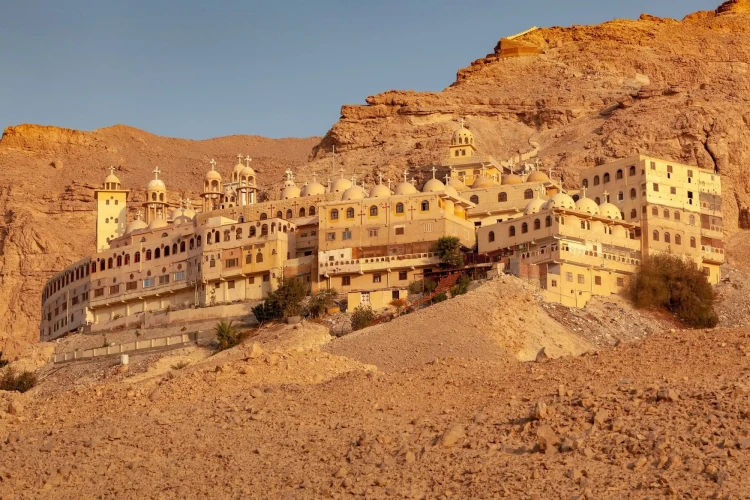
Heading toward the Red Sea coast brings you, to the foot of the rough Red Sea Mountains. Here you find two of the oldest still active monasteries anywhere, that are kind of hard to forget once you’re there.
Travel Tip: The Eastern Desert monasteries are about a 3.5-hour drive from Cairo, or closer to 2 hours from Hurghada, so it works nicely as a bridge between cultural exploring and that calm coastal rest.
1. Monastery of Saint Anthony
Founded around 356 CE by the followers of St. Anthony—the father of monasticism—this huge, self sustaining complex has multi-domed chapels, gardens fed by springs, and those vivid 13th-century wall paintings. If you feel energetic, you can climb the 1,190 wooden steps up the cliff face, to reach the natural cave where St. Anthony lived as a hermit for more than 20 years.
2. Monastery of Saint Paul the Anchorite
A quick drive through the mountain pass gets you to the sanctuary dedicated to St. Paul the Hermit. It was built right over the cave where St. Paul lived for almost 90 years, and inside, the subterranean Church of St. Paul holds ancient Coptic murals, hanging silver lamps, and medieval defense towers that still look surprisingly strong.
Practical Tips for Planning Your Tour
Best Season to Visit: If you’re planning a Coptic heritage tour, the sweet spot is usually from October through April, when the desert is less harsh, and temperatures feel mild enough for long walks around those unheated stone sanctuaries.
Dress Modestly: Monasteries and older churches are not just sightseeing spots, they’re living places of worship and community life too. So visitors should cover shoulders, chest , and knees, keep it modest and simple.
Check Church Calendars: Opening hours can change, especially around major Coptic Orthodox fasting seasons like Lent or the Fast of the Virgin Mary (August) . It’s smart to confirm your visiting times with a local guide before you go.





-webp.webp "Hilton")
-webp.webp "dusit")
-webp.webp "Marriott Hotels")
-webp.webp "Azimut Hotel")
-webp.webp "Golden Tulip")
-webp.webp "sheraton")
-webp.webp "westin hotel")
-webp.webp "Movenpick")
