
 English
 Italy
Italy
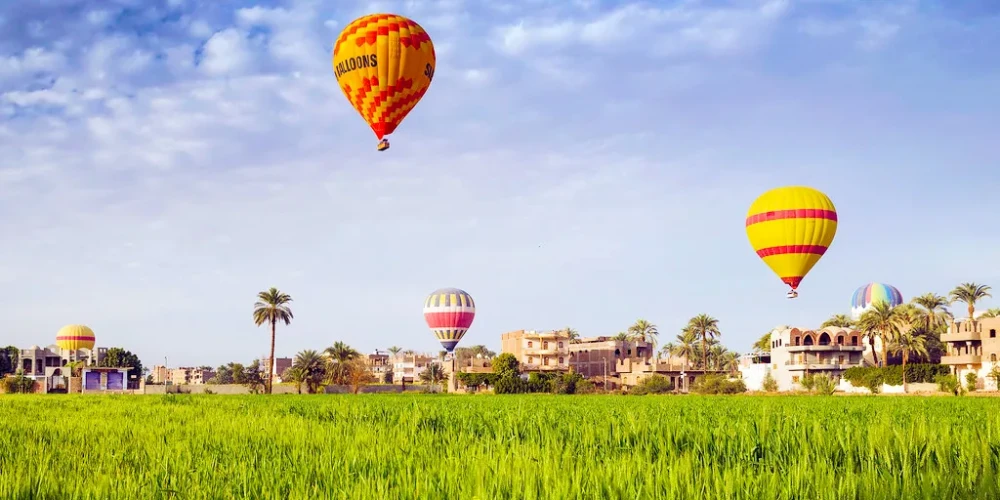
Bird’s Eye View: Spotting Ancient Temples and Green Fields from the Sky
Bird’s Eye View: Spotting Ancient Temples and Green Fields from the Sky
There is something deeply humbling and almost spiritual about viewing the world below from high up in the sky. Whenever visiting historical sites such as Luxor from below, one experiences all this beauty solely due to the magnitude and grandeur of the place; by strolling around enormous stone columns and walking through small, dark doorways, one can feel the weight of history surrounding him or her on all sides of the historic ruin.
However, the minute you soar above the ruins in the air balloon just as the sun starts rising, everything changes dramatically. History becomes an amazing living masterpiece before your eyes.
So let us journey to the silent morning clouds and discover what it feels like to see ancient temples, majestic rivers, and lush fields from up above.
1. The Living Canvas: Where Green Fields Meet Golden Sand
The very first thing that comes to your mind when dawn breaks into the sky are the physical features of the Nile Valley. Egypt is famous for its vast desert areas, but looking from up there you get the picture of an exact dividing line between life and death.
Looking to one side, you will see the bright, vividly colored belt of the Nile Valley. This belt consists of lush palm groves, banana plantations, well-farmed fields nourished by the ever-flowing waters of the river. But just hundreds of yards away from this green area, the contrast appears: the endless stretch of the golden-orange sands of the Western Desert.
This contrast becomes very clear when seen from up there. It immediately gives you an idea of thousands of years of civilization that was formed in this exact spot.
2. Spotting the Architectural Marvels of the West Bank
As your balloon quietly and smoothly floats over the West Bank of Luxor, you can see below you numerous ancient sites of archaeological importance that seem to be pieces on an ancient chessboard.
Mortuary Temple of Hatshepsut: As you fly overhead, the multiple levels of terraces belonging to this famous Egyptian Queen's temple resemble being carved right out of the giant limestone rock formation rising behind it. It is easy to observe all the processional ramps and architectural symmetry that helped create a harmonious union between ancient Egypt and the surrounding mountain.
Colossi of Memnon: These giant statues of King Amenhotep III are located in the middle of the fields and are definitely impressive when viewed from the earth surface. However, from the skies above, they seem to be eternal guardians watching over the centuries.
The Valley Outline: Although flight over the underground burial chambers of the Valley of the Kings is restricted according to aviation laws to protect this historical monument, one can easily observe the contours of the sun-burnt mountains with narrow gorges where the pharaohs concealed their tombs.
3. Catching Glances of Authentic, Daily Rural Life
The history of Luxor doesn't lie hidden within temples, in tombs or buried deep within desert sands — it is happening right before your eyes in the field villages as dawn breaks.
While floating quietly above rural communities that are slowly awakening for a new day, you are able to see a rare and candid picture of modern Egyptian life which ground travelers are never privy to. For instance, you might be lucky enough to see a native farmer walking a donkey down an old dirt road flanked by palm trees, excited children waving and yelling "Welcome to Egypt" from within a walled garden, or little plumes of smoke rising from the chimney of a small village as breakfast fires are lit.
Due to the fact that a hot air balloon travels at the same speed as the wind and the same direction of the current, you are not bothered with the noise of the engine or the rush of air.
Why This Perspective Changes Everything
It is quite common while exploring the old world to get confused with a whole lot of dynasties, dates, ancient kings, and scattered pieces of stones. However, once you soar high in the sky using hot air balloons, all those scattered pieces will be combined into a single and coherent story.
Once you gaze at the Nile snaking its way through the greenery and ancient structures, you would definitely appreciate the significance of this land in terms of civilization development. Actually, you are viewing the land the way ancient kings, farmers, and travelers used to view it many years ago.
Are you eager to see your first ancient temple from above or do you need some clarification on which specific landmarks you will be flying over?





-webp.webp "Hilton")
-webp.webp "dusit")
-webp.webp "Marriott Hotels")
-webp.webp "Azimut Hotel")
-webp.webp "Golden Tulip")
-webp.webp "sheraton")
-webp.webp "westin hotel")
-webp.webp "Movenpick")