
 English
 Italy
Italy
Beyond the Gold: The Uncut Story, Treasures, and Myths of Tutankhamun’s Tomb
The Tomb of Tutankhamun: The Golden Gateway to Ancient Egypt's Greatest Secret
On November 4, 1922, after years of grueling fruitless digging , in the sun baked rocks of the Valley of the Kings, the British archaeologist Howard Carter did stumble on something that would end up changing archaeology forever. Under ancient stone worker huts, that had been part of a later tomb , his group unearthed a single cut stone step, one that led downward into the ground. Then, by November 26, Carter had managed to carve a small opening into a sealed doorway at the bottom of a subterranean stair. With a candle held up, he tried to look into the hot, still air, and his eyes took their time slowly adjusting, to the darkness.
And when his patron, Lord Carnarvon, asked in a worryful hurry if he could see anything at all, Carter replied , in the line everybody repeats now: “Yes, wonderful things.”
The tomb KV62—final resting place of the young pharaoh Tutankhamun—was officially open. Unlike almost every other royal tomb in Egypt , which had already been systematically looted in antiquity, Tutankhamun’s tomb was found pretty much intact, packed with more than 5,000 priceless treasures.
So this is the full tale of KV62, the boy king’s tragic life, the grand discovery, the strange magic inside its chambers, and how it earned its permanent spot in global history.
1. The Boy King: A Short Life in a Turbulent Era
To really get the sheer volume of wealth inside the tomb, you kinda have to grasp the fact that Tutankhamun was, in the plain sense, a minor, short lived pharaoh.
He was born in the late 18th Dynasty (c. 1341 BC) , and he basically grew up while Egypt was stuck in the messy aftermath of the Amarna Period.
There was Akhenaten’s legacy: his father, the controversial “heretic” King Akhenaten, had done away with Egypt’s usual polytheistic pantheon, and tried to press everyone into the worship of just one sun disk, the Aten. At the same time, he moved the capital to Amarna, which only made things more complicated.
Then the old gods got pushed back in: when he ascended the throne at only nine years old, under the name Tutankhaten, the young ruler later switched to Tutankhamun (“The Living Image of Amun”). With the help of strong court power brokers, like Vizier Ay and General Horemheb, he left Amarna behind, returned the traditional religion, reopened the big temple spaces at Karnak and Luxor, and managed to bring a bit of order back to the Two Lands.
But then, a sudden end: at around eighteen or nineteen years old, King Tut died unexpectedly. Because the death seems to have hit so fast, his royal burial place was likely not finished. So they placed him, in a hurry, inside a smaller modified tomb that wasn’t meant for royalty, in the valley, and it was sealed up tight. After that, the whole thing got lost, and history pretty much moved on.
2. Inside KV62: Exploring the Four Sacred Chambers
Even if it is smaller than those sprawling subterranean palaces of Seti I or Ramesses II, KV62 still looks like it was planned to be a dense, organized cosmic hiding-place divided into four distinct spaces:
The Antechamber
When Carter’s group pushed past the second sealed door, they ended up in a room that felt kinda overflowing with chaotic luxury. Golden ceremonial couches carved into divine animal shapes, gilded chariots that had been taken apart for transport, alabaster perfume jars, royal chairs, and those huge black-and-gold guardian statues all seemed to crowd around, with the sealed entrance to the burial chamber sitting there, sort of looming.
The Annexe
From the Antechamber, a smaller area opened up, packed up with day-to-day objects that were meant for the king’s comfort in the afterlife. You could find wine jars, board games like Senet, fine linens, bow-and-arrow sets, royal sandals, plus carved wooden models of ships. It reads more like collected belongings than carefully displayed treasure, if that makes sense.
The Burial Chamber: The House of Gold
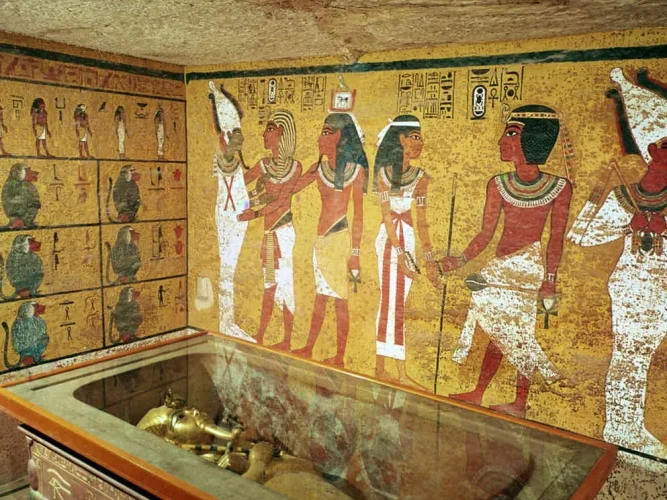
This was the only chamber inside the tomb with painted wall plaster, and it contained the king’s mummified body within an extraordinary nested “box within box” arrangement:
Four Gilded Shrines
Four massive wooden shrines, all covered in gold leaf, were made to fit tight into each other like Russian nesting dolls , except far more heavy and ceremonial.
The Quartzite Sarcophagus
In the center, inside the innermost shrine, sat a single carved red quartzite sarcophagus.
Three Nested Coffins
Inside that stone sarcophagus were three coffins. The outer two were wooden and wrapped in gold foil, while the innermost coffin was made from solid heavy gold, and it weighed more than 110 kilograms, (about 240 pounds) roughly.
The Treasury
The Treasury area is associated with a striking black-and-gold statue of Anubis perched on top of a shrine. There the tomb’s most sacred items were kept: a delicate alabaster Canopic Chest containing four miniature gold coffins that held the king’s mummified internal organs. Around that, there were royal jewelry pieces, golden statuettes, and fine furniture as well.
3. Masterpieces of the Golden Treasures
The thousands of artifacts pulled out from KV62 basically show the absolute top of New Kingdom Egyptian craft: metalwork, glassblowing, stonemasonry, and all the fine attention you can imagine.
The Golden Death Mask: This one, weighing more than 10 kilograms of solid gold, is inlaid with lapis lazuli, turquoise, carnelian, and obsidian. The mask sat right on top of the kings mummy head. It shows Tutankhamun with that quiet, unbothered immortal look, wearing the royal nemes headcloth, and also the protective vulture and cobra deities, the Uraeus, up on his brow.
The Golden Throne: A real jaw-dropper wooden chair, coated with gold, silver, glass and precious stones. The backrest keeps a rather intimate household moment, with young Queen Ankhesenamun calmly applying scented oils to Tutankhamun, like it’s a small ritual under the warm sun disk rays.
The Meteorite Dagger: It was tucked inside the mummy’s wrappings. One of Tutankhamun’s iron daggers was later examined by modern scientists and it turned out to be made from a fallen iron meteorite, basically the kind of metal the Egyptians called “iron from heaven.”





-webp.webp "Hilton")
-webp.webp "dusit")
-webp.webp "Marriott Hotels")
-webp.webp "Azimut Hotel")
-webp.webp "Golden Tulip")
-webp.webp "sheraton")
-webp.webp "westin hotel")
-webp.webp "Movenpick")