
 English
 Italy
Italy
Beyond Giza: Inside the Red-Hued Blueprint for the Great Pyramids
The Red Pyramid: Ancient Egypt’s First True Engineering Triumph
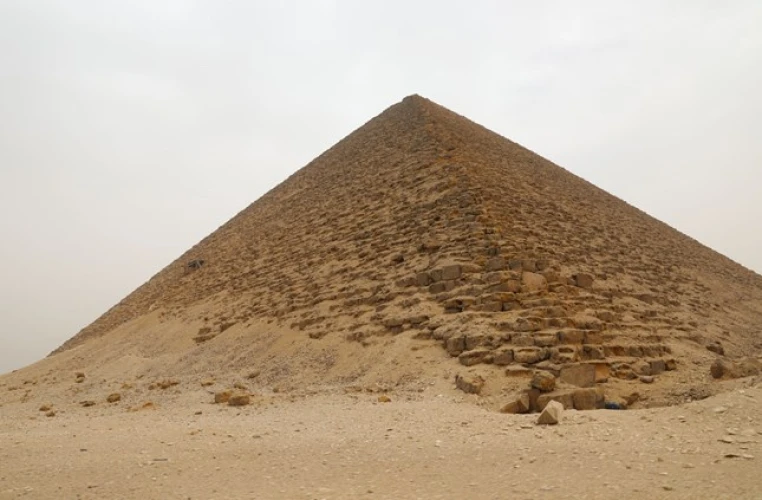
Rising kind of quietly out of the desert sands at Dahshur, roughly 40 kilometers south of Cairo, there sits a monument of monumental historical magnitude , you know, The Red Pyramid. It’s also called the North Pyramid, and this massive thing is the third-largest pyramid ever built in Egypt, only beaten in height and overall scale by the famous Great Pyramids of Khufu and Khafre up at Giza.
Still, for all that immense size and the weight of its history, the Red Pyramid often gets way less global attention than its Giza counterparts. For travelers and history fans, this quiet distance is almost a blessing, it feels like a calm corridor rather than a crowded avenue. You can get a more intimate, uncluttered look at what many people call the most crucial architectural breakthrough in human history: the world’s first successfully built, smooth-sided true pyramid.
Commissioned by Pharaoh Sneferu (c. 2600 BC), the founding king of the Fourth Dynasty, the Red Pyramid is basically the sheer win of ancient Egyptian engineering after years of daring trial, error, and mid-construction adaptation, like they adjusted along the way , without losing the plan.
1. The Red Legend: Why Is It Called "Red"?
To a modern visitor coming toward the Dahshur necropolis, the pyramid’s special rusty red color pops right away, mainly under the golden glow of the late afternoon sun. Still, the monument was not always red, or, at least not in the way we see it now.
The Missing White Casing
Like all the big Fourth Dynasty royal tombs, the Red Pyramid was originally dressed in a striking outer coat of fine, very polished white Tura limestone, quarried across the Nile. When it was first finished, the pyramid shone like a glaring white mirror, in that desert heat, hiding the stone masonry underneath.
Over thousands of years, and especially through the medieval period, quarrymen went about stripping away the precious white Tura casing in a steady kind of routine. They needed the stone for palaces, mosques, and fortifications around Cairo. Once the outer layer was removed, the pyramid’s underlying structural blocks showed through, they were made of a local, iron bearing reddish limestone quarried pretty much near the site. That warm, reddish pink tone is what gave the monument its current label: The Red Pyramid, known locally in Arabic as El-Haram el-Ahmar.
2. Sneferu’s Journey: From Structural Crises to Perfection
To really get why the Red Pyramid counts as an engineering win, you kinda have to stare at King Sneferu’s long, stubborn focus on pyramid work. Sneferu was, arguably, the most accomplished builder of the ancient world, hauling and arranging more stone masonry than any other pharaoh , before or after him.
The Red Pyramid was actually Sneferu’s third big pyramid effort:
The Meidum Pyramid: Sneferu’s first real attempt to turn an eight-stepped form into a smooth-sided pyramid ended badly, the outer casing started failing, then the whole thing collapsed, like it just gave up.
The Bent Pyramid: Sitting only about one kilometer south at Dahshur, it was planned as a smooth pyramid with a very steep 54-degree slope. But part way through, serious ground shifting, plus internal fractures, made the builders change course fast , they flattened the angle down to 43 degrees, and that’s how the “bent” look happened.
The Red Pyramid: After he learned those important takeaways—weight distribution, slope angles, and how stone should be positioned—his teams nailed it on the third attempt.
The “Magic Angle” : 43 Degrees
Once his engineers noticed that a steep 54-degree slope caused brutal inward and outward crushing forces, they set the Red Pyramid from bedrock all the way up using a gentler, more dependable 43-degree angle. It’s basically the same safer angle that was used to finish the upper portion of the Bent Pyramid.
Then they spread the sheer mass , more than 3.5 million tons of limestone, across a broader footing (220 meters on each side). The result was a structure that felt balanced, geometrically confident, and it climbed to a height of 104 meters , which is about 341 feet.
3. Journey into the Abyss: Inside the Burial Chambers
While the outer face of the Red Pyramid is kind of an engineering marvel, its interior plan feels just as jaw-dropping. Unlike other pyramids where you end up squeezed through super tight corridors, stepping into the Red Pyramid turns into one of those really memorable underground trips in Egypt, for real.
The Descending Corridor
People typically enter via an opening set high on the northern face, about 28 meters above ground. After that, there’s a long, straight, dim wooden ramp and it slopes down at roughly a 27 degree angle , running for more than 60 meters (about 200 feet) into the deep interior.
The Corbelled Vaults
Once you reach the bottom, the passage opens up into two huge, matching ante-chambers, linked by a short stretch of corridor:
Towering Heights: Each room has this remarkable corbelled or vaulted ceiling that steps inward, layer after layer, and it climbs to something like over 12 meters (40 feet).
Weight Distribution: This upside-of-an-staircase masonry method was a neat innovation, created so the crushing force from the immense stone mass above, didn’t push directly onto the exposed open areas below.
The Burial Chamber
From the second room, a raised wooden staircase leads upward into the main Burial Chamber. It sits right under the pyramid’s apex, and it holds a huge corbelled ceiling that’s around 15 meters high. Even though grave robbers emptied the king’s treasures ages ago, workers still found fragments of human remains and some small wooden burial pieces inside. Those finds basically confirm that this space was the final resting place of Pharaoh Sneferu.





-webp.webp "Hilton")
-webp.webp "dusit")
-webp.webp "Marriott Hotels")
-webp.webp "Azimut Hotel")
-webp.webp "Golden Tulip")
-webp.webp "sheraton")
-webp.webp "westin hotel")
-webp.webp "Movenpick")
