
 English
 Italy
Italy
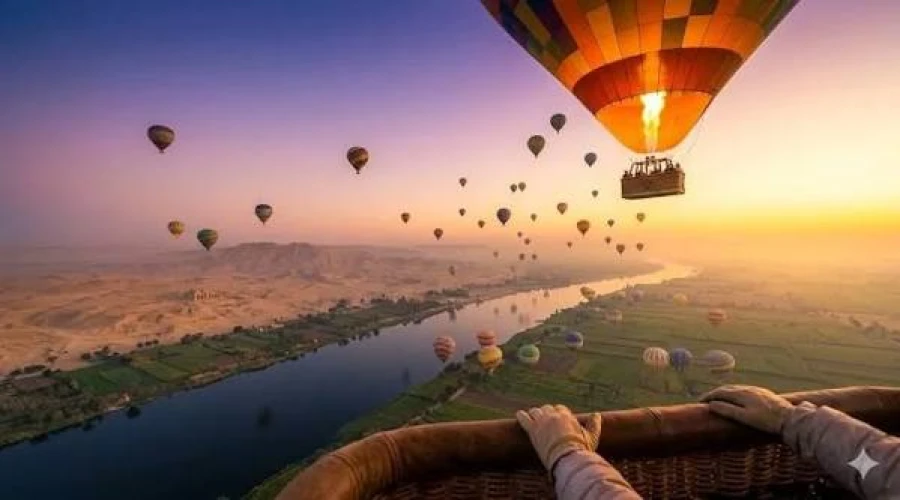
Capturing Magic: Best Angles and Tips for Photographing Luxor from Above
Capturing Magic: Best Angles and Tips for Photographing Luxor from Above
There are not many places in the world that provide such a powerful visual contrast as Luxor from the air. On one side of your lens is the dark blue and silver hues of the twisting Nile river, but then, just a second later, the camera shows you the incredibly sharp line of separation between the green palm groves and the endless golden sand dunes of the desert.
When you are floating at a great height above the ruins of an ancient civilization as the sun rises in front of you, it is only natural that you will want to document every single second of it. However, capturing amazing pictures from the constantly moving basket of a wicker balloon is not an easy feat by any stretch of imagination.
This is your masterclass on composition angles, camera settings, and necessary equipment for shooting Luxor from the skies like a professional.
1. The Essential Compositions to Chase During Your Flight
Before you start photographing whimsically from all sides of the basket, remember to watch for these classic images, which are the hallmark of a Luxor hot air balloon ride:
River Ribbon: Capture the sinuous flow of the Nile as it flows through the middle of the valley. Shoot vertically downward or diagonally to emphasize the importance of this one river as life force for an entire ecosystem in the midst of a harsh desert environment.
Desert Contrast Line: Seek out the striking boundary line where the lush green of cultivated fields gives way to the sandy gold of the Western Desert. This symbolizes the ancient division of life and death, as well as the physical separation between the “Land of the Living” (temples of the east bank) and the “Land of the Dead” (tombs of the west bank).
Bird’s Eye View of Ancient Ruins: Ensure that you have your camera at hand and keep it on as you soar towards funerary temples such as the magnificent multi-level temple of Hatshepsut or the massive Colossi of Memnon. The overhead view will provide you with the architectural plans which remain unseen while exploring the ruins on foot.
The Art of Casting Shadows: After sunrise, with the sunlight flooding the entire valley, turn your gaze downwards or backwards to see the large shadow cast by your balloon itself, drifting across the fields below.
2. Camera Settings & Technical Tips for Aerial Photography
Of course, it is not mandatory to use an expensive and professional DSLR camera or any other mirrorless one to have some fantastic pictures; nowadays, the capabilities of smartphones are unbelievable. But to ensure the highest quality of photographs without any unnecessary motion blur, it is important to know several technical things:
Make sure that the shutter speed is high enough: As the balloon always floats dynamically because of the wind currents, your shooting position is not absolutely stable. Set the shutter speed to be no less than 1/500 seconds in order to get rid of the motion blur effect.
Golden Hour lighting: Take advantage of the warm and soft directional lighting during the initial 15-20 minutes after sunrise when the landscape is lit with a warm golden light that accentuates the texture in a wonderful manner. Use exposure compensation to capture highlights in the sky without letting the shadows in the ground go completely into murky darkness.
Wide angle first, then zooming: Begin by shooting at wide angles to capture the grandeur and epic scale of the entire valley. Once you get all your landscape shots ready, then move closer for telephoto shots using lenses or 3x/5x optical zoom from your phone.
3. Safety and Gear Management in the Basket
Taking photos while seated in a basket alongside other tourists means that one has to have some physical awareness:
Make sure to use a good wrist strap: This is something that cannot be negotiated. If you happen to lose your smartphone or camera from 1,000 feet above the ground, then you can never find it again. It will just fall into oblivion. Make sure that your gadgets have a reliable wrist or neck strap.
Travel as lightly as possible: No need to carry any heavy luggage or tripods or even additional camera lenses. One only needs a good camera or a smartphone and that should be enough. It is totally impractical to use tripods on such an adventure as they are extremely heavy and may cause injuries.
Be considerate of your fellow basket riders: Each basket is compartmentalized and thus you are going to be accompanied by other avid photographers. Always mind the fact that you will need to share the space and therefore give your fellows a chance to lean out for good pictures.
The Most Important Rule: Put the Camera Down
It is quite astonishing how one may get too focused on capturing the perfect exposure, the LCD display, and shooting video after video that he/she ends up experiencing the whole 45-minute ride in just a mere 6-inch window of glass.
Capture those wide-angle shots. Get that close-up shot of the historic temples. Capture that beautiful sunrise. However, after taking all those shots, turn off the camera for at least five minutes.
Relax those forearms on the sturdy wicker frame, close your eyes and experience the sheer silence of the skies, and watch that magic happen with your very own eyes. Witness Luxor as it comes alive underneath you. It is a core memory that no camera sensor can ever truly capture.





-webp.webp "Hilton")
-webp.webp "dusit")
-webp.webp "Marriott Hotels")
-webp.webp "Azimut Hotel")
-webp.webp "Golden Tulip")
-webp.webp "sheraton")
-webp.webp "westin hotel")
-webp.webp "Movenpick")
