
 English
 Italy
Italy
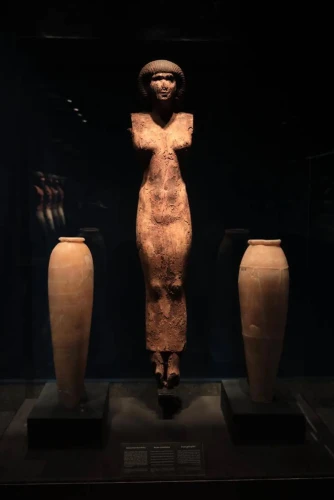
Architect, Doctor, God: How Imhotep Revolutionized Ancient Egypt
Imhotep: The Renaissance Man of Ancient Egypt Who Became a God
In that long, illustrious timeline of ancient Egypt, history is mostly written by and for pharaohs. Their names got carved into granite obelisks , their faces were sculpted into giant limestone colossi and their deeds were recorded as divine triumphs. Still, up there among these mighty kings is a commoner who did something even more unusual: a man whose sheer intellect artistic imagination, and scientific brilliance lifted him from a humble royal scribe to a celebrated cultural hero, and later on, to a worshiped god.
That person was Imhotep (which is often rendered as “He Who Comes in Peace”). He served during the Third Dynasty of the Old Kingdom (c. 2670 BC) under King Djoser, and in a way, he is history’s first well documented genius. He wasn’t just one thing, he was a master of many fields, excelling as a royal architect, a high priest, chief physician, vizier , astronomer , and poet—sometimes all at once.
Long before Leonardo da Vinci even thought about flying machines, and far before Hippocrates put pen to paper on his medical oaths, Imhotep was already building the groundwork for monumental stone architecture and for a disciplined approach to medicine along the banks of the Nile.
So this is the full account of Imhotep, his beginnings that were less than grand, his inventions that changed expectations, his medical legacy, and that rare road from living man to something closer to godhood.
1. The Chief Architect: Inventing the Stone Pyramid
Before Imhotep’s era, ancient Egyptians were mostly using organic, sort of perishable materials , like sundried mudbrick, reed mats, wood, and palm trunks. Even the tombs of kings were basically flat, single-story mudbrick structures, usually called mastabas, and that’s that.
Then King Djoser ascended the throne and he wanted something that could show his divine power, but also endure for eternity, which was kind of… well, unrealistic. So he handed this whole vision over to his brilliant chancellor, Imhotep.
The Saqqara Revolution
Imhotep understood that if a king’s spirit was meant to live forever, his tomb needed an imperishable medium, and that medium had to be carved limestone.
He didn’t simply “use stone” either. Instead, he developed the core engineering methods needed for quarrying, shaping, moving, and aligning heavy stone blocks. And his plan for Djoser’s tomb at Saqqara came together in stages, like a careful sequence of upgrades, not just one straight line.
Stacking Mastabas: he came up with the strange but convincing idea of stacking stone mastabas on top of each other, each one smaller than the previous.
The Step Pyramid: the end product became a tall, six-tiered stone monument rising to about 60 meters (197 feet). That was the Step Pyramid of Saqqara. It was the tallest structure in the world back then, and it also became the first major stone building on a large scale in human history.
Around the pyramid, Imhotep designed this huge 15-hectare walled complex, with stone shrines and ceremonial courts, plus an intricate 5.7-kilometer underground labyrinth of carved limestone tunnels.
2. The Father of Medicine: Science over Magic
While modern popular culture, mostly pulled along by Hollywood films like The Mummy, misrepresents Imhotep as some evil priest or sorcerer, but the historical record, in reality, points the other way. He appears to have been rather a pioneering man of science, specially in medicine.
In ancient Egypt, medicine was deeply mixed with magic, restless spirits, and divine intervention. Imhotep on the other hand seemed to push a kind of evidence-first approach, more like careful watching and testing than pure enchantment.
The Edwin Smith Papyrus
Quite a few prominent historians think Imhotep was either the author, or at least the early source behind the renowned Edwin Smith Papyrus, a medical document that goes back to the Old Kingdom,
Systematic Diagnosis: The text treats illness in a fairly logical cadence, it observes, then assesses, then proposes treatment, and finally it weighs a prognosis.
Surgical Realism: It lays out 48 individual surgical cases, mostly tied to head injuries, spinal damage, fractures, and tumors, with practical notes on how to set bones, stitch up wounds, and handle infections, often using honey and lint.
Anatomy Insights: It includes some of the earliest written descriptions of the human brain, the cranial sutures, and even the cardiovascular pulse.
Because of this, Imhotep’s name became linked with healing in a way that lasted a very long time. Egyptian physicians reportedly relied on his teachings for thousands of years, treating him as their kind of spiritual patron.
3. The Vizier and Polymath: Administrator of the Realm
Beyond architecture and medicine, Imhotep seems to have served as King Djoser’s Vizier (Tjaty) , which was basically the top political post in ancient Egypt—kind of like a modern prime minister.
In practice, Imhotep handled the administrative , economic and judicial parts of government , day to day.
High Priest of Ra: at Heliopolis, he blended solar theology with state politics, so the king’s role as the earthly son of the sun god Ra felt more solid and official.
Master Craftsman: he supervised the royal workshops, stone working guilds, and the sculpture studios, this helped push artistic quality up across Upper and Lower Egypt.
Royal Favor: Djoser held him in such close esteem that he bent the usual royal rules, by letting Imhotep’s name and titles be carved right onto the base of a royal statue of the king at Saqqara. That kind of recognition for a commoner was, frankly, unprecedented.





-webp.webp "Hilton")
-webp.webp "dusit")
-webp.webp "Marriott Hotels")
-webp.webp "Azimut Hotel")
-webp.webp "Golden Tulip")
-webp.webp "sheraton")
-webp.webp "westin hotel")
-webp.webp "Movenpick")