 English
 Italy
Al-Ashmonein: The Historical and Archaeological Heritage of Hermopolis Magna
The area of Middle Egypt is rich with ancient archaeological sites that have been under the rule of the Pharaohs, Hellens, Romans, Byzantines, and Muslims. Surprisingly, many places in this region were not so well-known despite their significant contribution to the ancient history of Egypt. One of these places is Al-Ashmonein or Hermopolis Magna located on the western bank of the Nile in the Minya Governorate. This ancient city used to be an essential religious, intellectual, and administrative center of Egypt many centuries ago. Devotion to the God of Wisdom and Writing Thoth, the presence of knowledge and learning, and unique architectural constructions are the remarkable features of Al-Ashmonein. The purpose of this paper is to explore this ancient city and learn more about its geographical location, mythology, architectural structures, and Graeco-Roman civilization.
1. History, Geographical Location, and Namesake of Hermopolis Magna
The modern-day village of Ashmonein is located in the center of Egypt. This region used to be the borderland between Upper and Lower Egypt.
A. Interpretation of the Modern Name and the Ancient Name’s Meaning
The name of this place has gone through several changes throughout history. According to existing historical reconstructions, the modern name, Al-Ashmonein, derives from the ancient Egyptian name, Khemenu, meaning “The City of the Eight.” It got its name due to the existence of the Ogdoad, which is a set of eight creator Gods worshipped by the Hermopolitan priests. The city was further renamed Hermopolis Magna (“The Great City of Hermes”) by the Greeks who equated the Egyptian God Thoth with the Greek God Hermes. Then, the name of the city changed to Shmouj or Hermoupolis in Coptic, which is the present-day Arabic name.
B. The City’s Strategic and Economic Value
The ancient city had the most strategic location near the Bahr Youssef canal, which is a branch of the Nile. It allowed the city to control the fertile area of the Nile Valley. Being the capital of the fifteenth Nome of Upper Egypt, Hermopolis Magna remained a prosperous city due to its advantageous location at the intersection of trade routes of the Nile and the oases.
2. Mythology: Creation Story and the Role of the Gods
The local mythological beliefs of the ancient Hermopolis are closely related to the creation story of the world.
A. The Hermopolitan Creation Story
The priests of Hermopolis developed their own interpretation of the creation of the world many centuries ago. According to this story, the world was created from the waters of the cosmic ocean ruled over by the God Nun. Gods created the first land by drying up some of the waters. The four male and four female deities of the Ogdoad were considered to be the creators of the world. These Gods were divided into pairs: Nun and Naunet, the deities of water; Heh and Hauhet, the deities of infinite space; Kek and Kauket, the deities of darkness; Amun and Amunet, the deities of hidden powers. These eight Gods created the cosmic egg from which the sun was hatched to bring light to the world.
B. The God Thoth and His Role in the World
The local God Thoth was believed to be the God of Wisdom and Writing who taught the people to communicate and develop the system of writing. He created the hieroglyphic script and was also the God of Magic and Astronomy. In many myths, he was portrayed as an ibis or a baboon. The God of Wisdom and Writing had the role of the judge of disputing Gods. He was the one to heal Horus’s eye and to assign the judgment of the dead in the Hall of Osiris. Due to the high status of the God, his temple became a popular destination for the pilgrims. It is believed that thousands of them brought the mummified ibises and baboons to the temple as a gift to the God. Therefore, the subterranean caves of Hermopolis Magna were filled with millions of animals’ mummies.
3. Main Architectural Constructions of Ancient Hermopolis
Despite being partially buried by sand and modern villages, the ancient city of Hermopolis Magna has a plenty of impressive architectural constructions.
A. The Great Temple of Thoth
The ancient city’s most notable structure is the large temple complex dedicated to the God of Wisdom and Writing, Thoth. It is believed that the temple existed since the New Kingdom and was expanded multiple times during the Ptolemaic and Roman periods. The massive gateposts, papyrus-shaped columns, and beautiful rock-cut sanctuaries were impressive to the ancient people. Although the majority of the sandstone building material was stolen for construction purposes, several large statues of baboons throwing can make the modern people speechless.
B. The Graeco-Roman Portico and Basilica
The most prominent buildings found in Al-Ashmonein belong to the Graeco-Roman period and date back to different periods:
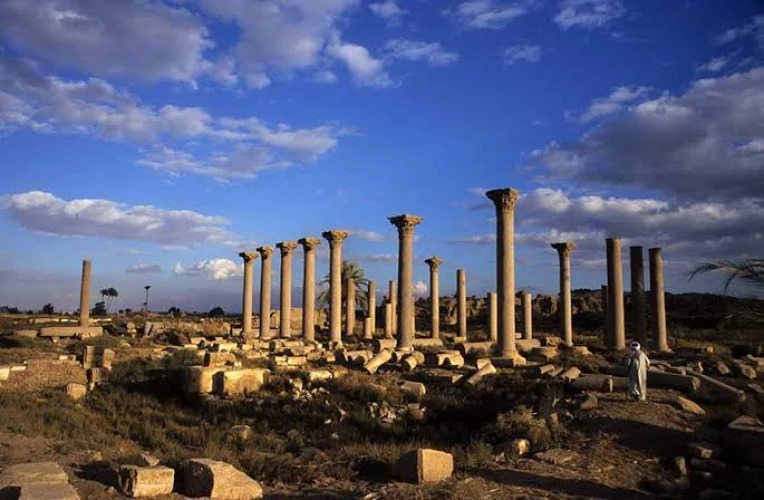
The Roman Agora and Portico are decorated with Roman-style excavated columns. They represent the Hellenistic influence on the city’s architectural constructions.
The Christian basilica of the fifth century AD is a prime example of a Graeco-Roman temple built with spolia from ancient pagan buildings.
4. Graeco-Roman and Byzantine Civilizations in Al-Ashmonein
Many scholars state that the city of Hermopolis Magna has a rich history of being a center of intellectual culture.
A. The Centers of Learning
Due to the high reputation of the God Thoth, his priests and scholars used to gather in Hermopolis to study and teach others. The city became an important center of learning and scientific knowledge that combined the deep wisdom of the ancient Egyptian priests and the cleverness of the Greek scholars. It was in Hermopolis that alchemy, astrology, and philosophy were developed.
B. The Transition to the Islamic Period
After the Arab conquest, Al-Ashmonein remained an administrative and agricultural center of the region. The ancient temples were abandoned, while the local inhabitants converted to Islam. Nevertheless, the city remained an important settlement due to its rich agricultural resources and supplied the local mosques with its ancient sandstone building material.
To conclude, Al-Ashmonein or Hermopolis Magna is a city with a long and rich history that has been playing an important role in the development of ancient Egyptian civilization. From being the sacred city of Gods and the creator of hieroglyphic writing to becoming the center of Graeco-Roman intellectual culture, Hermopolis Magna has served many purposes. This archaeological site remains a place of great interest not only to the modern people but also to the ancient ones who admire the wisdom, knowledge, and beliefs of the first ancient Egyptians.