
 English
 Italy
Italy
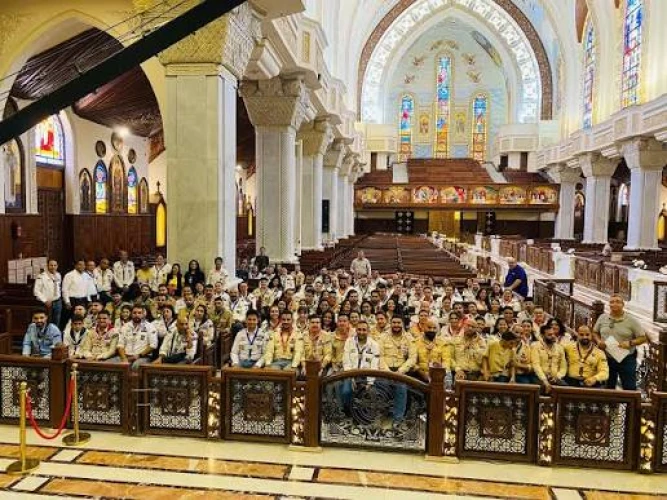
A Modern Beacon for an Ancient Faith: The Story of Abbassia’s Great Cathedral
Saint Mark's Coptic Orthodox Cathedral in Abbassia: History, Architecture & Sacred Heritage
Standing in the Abbassia district of Cairo, Saint Mark's Coptic Orthodox Cathedral is like the central seat for the Coptic Orthodox Church of Alexandria and also the official dwelling of the Coptic Pope. It was inaugurated in the late 1960s, and since then this grand cathedral compound has been seen as a worldwide emblem of Coptic Christianity , sort of a monument of 20th-century architectural drive, and at the same time a holy refuge where priceless historical keepsakes are kept, preserved quietly.
For several decades, it was regarded as the largest cathedral in the Middle East , so the Abbassia complex feels tied to a modern renaissance of the Coptic Church. This is more than a mere church building, it works as a active administrative and spiritual place for millions of believers, also it acts like a living link between present-day Egypt and its deeply rooted apostolic heritage.
Below you will find the full story, architectural importance, sacred relics, and the wider cultural ripple caused by Saint Mark's Cathedral in Abbassia, Cairo.
1. The Origins: A Modern Vision for an Ancient Church
While the historical See of Saint Mark was sort of originally set up in Alexandria in the 1st century AD, over the centuries, political and administrative shifts somehow nudged things along, and so the papal residence was moved to Cairo in the 11th century.
For many years, the main patriarchal seat was kept within older churches across Old Cairo, then later it was housed at St. Mark's Cathedral in Azbakeya. Still, as the Coptic population grew fast during the 20th century, the Church needed more spacious arrangements, a bigger place, really, for hosting grand liturgical celebrations, international conferences , and also pastoral gatherings.
In the 1960s, under Pope Cyril VI (the 116th Patriarch of Alexandria) , plans were started to build a monumental cathedral in Abbassia, on land that had been historically owned by the Church, known as the Anba Rouiss grounds. The project also drew strong national backing, including a notable contribution from Egyptian President Gamal Abdel Nasser, who laid the foundation stone together with Pope Cyril VI in 1965.
2. The Historic Inauguration of 1968
The grand opening of Saint Mark’s Cathedral on June 25, 1968, was one of the most momentous events in modern Egyptian and Christian history, honestly it felt bigger than it should.
The inauguration ceremony somehow brought together prominent religious and political leaders from around the globe , including Emperor Haile Selassie of Ethiopia, representatives from the Vatican, Eastern Orthodox patriarchs, and Protestant leaders.
The event was celebrated not just as a spiritual milestone, but also as a strong message of national unity and historical pride , like a quiet, steadfast declaration. It marked the official dedication of a new spiritual home for the Coptic Orthodox Church, showing its worldwide reach and that long living heritage in the modern era.
3. The Return of the Relics of Saint Mark
The inauguration of the Abbassia Cathedral got tied, kind of directly, to a deep spiritual recovery, like the return of the holy relics of Saint Mark the Evangelist to Egypt, and yes it mattered a lot.
Back in 828 AD, relics of Saint Mark had been taken from Alexandria to Venice Italy. Later, after long diplomatic and ecumenical endeavors, led by Pope Cyril VI , the Catholic Church did return part of Saint Mark’s relics to the Coptic Church in June 1968.
When the relics finally reached Cairo, they were set in a specially arranged marble crypt under the main altar of the freshly built Abbassia Cathedral. Nowadays pilgrims from everywhere go down into this underground sanctuary, to pray close to the shrine of the apostle who first carried Christianity into North Africa.
4. Architectural Splendor: Engineering and Iconography
Saint Mark's Cathedral in Abbassia was crafted by well known Egyptian architects and engineers, it sort of merges venerable Coptic architectural ideas with a more modern mid-century structural approach. And yes, it feels like the two vibes are sitting together, even if the proportions look a little too confident, for some reason.
Structural Scale and Design
The Main Nave: The cathedral has a big central hall that can host more than 5,000 worshippers on the biggest holy days, like Christmas and Resurrection liturgies.
The Twin Towers: Two towering bell towers rise fast over the whole complex, they basically dominate the Abbassia skyline, and they pull the faithful toward prayer.
Monumental Arches: Wide concrete arches hold up tall vaulted ceilings, which means inside you get this enormous, open arrangement with hardly any columns blocking your view.
The Iconography and Altar Space
Inside, the cathedral is adorned with bright, contemporary Coptic iconography guided by celebrated master artists. The main sanctuary is arranged around a towering wooden iconostasis, also called an icon screen, with hand carved details and big painted panels, showing Christ, the Virgin Mary, Saint Mark and the Heavenly Hosts. Up high, large stained glass windows let warm sunlight drift into the hall, and it lands on the marble floors, turning them into a kind of colorful shimmer.
5. The Heart of the Coptic Patriarchate
Beyond its role as a church, the Abbassia complex basically works as the operational heart of the Coptic Orthodox Church world wide.
The Papal Residence
Inside, there is the official Papal Residence and the administrative headquarters of the Coptic Pope. From there, Pope Tawadros II (the current Patriarch of the See of St. Mark) steers church affairs, meets with international dignitaries, and gives weekly theological lectures to thousands of attendees, and also to online viewers.
The Shrine of Pope Cyril VI and Saint Athanasius
Besides the relics of Saint Mark, the cathedral grounds include shrines dedicated to other pivotal personalities in Coptic history. The crypt complex contains relics connected to Saint Athanasius the Apostolic, the great defender of the Nicene Creed, which were brought back from Rome in 1973. The same place also works as a center for devotion to Pope Cyril VI , where his legacy of prayer and leadership keeps inspiring millions.
Education and Cultural Centers
On the grounds you’ll also find the Coptic Theological Seminary , the Higher Institute of Coptic Studies, historic libraries, and administrative offices tied to global mission work , so the whole area feels alive with education, scholarly research, and community service.
6. Global Significance and Contemporary Legacy
Today, Saint Mark's Coptic Orthodox Cathedral in Abbassia stands as a kind of beacon, for faith and also for cultural preservation, almost like it’s breathing history. It is the place where the major national celebrations are broadcast across Egypt, and also among the international Coptic diaspora. During holy seasons, the cathedral fills to capacity with worshippers, civil leaders, visitors, and people who come together in one shared mood of prayer and celebration , yes really.
Through its grand architecture, the sacred crypts, and its active spiritual life, the cathedral keeps the ancient inheritance of Saint Mark alive, while also guiding the Coptic Church forward in the 21st century, step by step, slowly but sure.





-webp.webp "Hilton")
-webp.webp "dusit")
-webp.webp "Marriott Hotels")
-webp.webp "Azimut Hotel")
-webp.webp "Golden Tulip")
-webp.webp "sheraton")
-webp.webp "westin hotel")
-webp.webp "Movenpick")
