
 EN
 IT
 ES
 FR
 ZH
古埃及绘画与比例法则:艺术技法的演变
1. 干式灰泥技术与天然矿物调色板
埃及的壁画通常被描述为湿壁画,但这种技术在埃及从未使用过,所有的绘画都是在干燥的表面上完成的。最早的绘画是绘在涂有泥的灰泥上,后来的则是在石膏或白灰灰泥上进行的。使用的颜色都是天然矿物制成的,绿色用孔雀石,红色和黄色用赭石或赤铁矿,白色来自石膏,黑色来自烟灰,蓝色是一种皇家颜色,来自研磨的青金石、法益瓷或碳酸铜。有时使用蛋清作为粘合剂。对所使用的颜色和方法仍需进行更多的分析研究。
2. 工匠的视角、语言风格与主要创作线路
In drawing, the first sketch -was made in red by the master craftsman, corrections were shown in black, and the Egyptians early became masters of the straight line. Corrections were difficult to hide: they could be cut away or plastered over and painted, but sometimes the plaster has fallen away and the original mistakes exposed: these are clearly seen in several scenes shown on the walls of Madinat Habu (Rte 36). Although the Egyptians squared out the walls of the temples and tombs they were about ue was neveto decorate, they had consider-able difficulty in representing the human form. There was little true perspective, although it does occur in isolated instances,. as at al-Amarnah in the painting of the two princesses, and in the temple of Seti I at Abydos. Distances were shown by representing the scene in registers, the desert at the top, the main scenes in the middle, and the river at the bottom. The craftsmen drew from memory and human figures were almost invariably represented with the face in profile, very few figures are ever shown full face, but they had much more success with animals and plants. Although the names of many of the Egyptian architects are known, the same is not true for the artist-craftsmen who adorned the temples and tombs.
3. 比例规范:跨朝代的网格系统
A canon of proportion was followed by the Egyptians which varied slightly at different periods. The measurements were never taken to the top of the head, but from the hairline, or where the headdress began: on the upright standing or walking male figure this was the standard. In the Old Kingdom it was 9 units from the head to the foot, calculated as follows: hair to shoulder 1 unit, shoulder to the hem of kilt 5 units, hem of kilt to ground 3 units. In many of the tombs where the paintings are unfinished the squared background can be observed. Thus in the Tomb-Chapel of Ukht-hetep at Meir there are 18 squares from the edge of the hair to the foot. The Middle Kingdom figures are not so squat as those of the Old Kingdom but in the New Kingdom there is a return to the 9-unit form with an extra half unit for the upper part of the head. At al-cAmamah the proportions are slightly different as the head is much larger than the standard one ninth of the body. In the 26 Dyn. the canon changed from 18 to 21 squares, the head occupying just over two squares and thus being smaller in proportion.
4. 皇冠与格子裙:王室与神圣服饰的演变
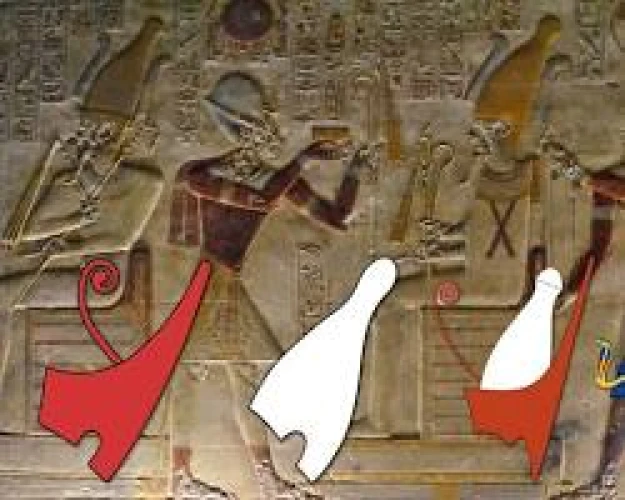
There is considerable variety in the headdresses and kilts of the various periods, so that even without an inscription, usually on the back pillar and the base, it is quite easy to make ascriptions to the correct period. In the Old Kingdom wigs were usually tightly curled close to the head, or parted in the middle and worn shoulder length, while kilts were of a plain and simple design. Women wore plain long skirts with two straps over the shoulders. In the Middle Kingdom the design of the knotting on the wig changed, and although shoulder length hair was still worn the proportions were not the same as the Old Kingdom. In the New Kingdom hair styles became much more INDEX OF EGYPTOLOGISTS elaborate, lotus buds and flowers were often worn in the hair, and the kilts became loRger and more closely pleated. The kings wore a great variety of headdresses. The most usual was the nemes head cloth, a blue and white striped linen covering with lapetts. These are even in the Old Kingdom, irregular in the Middle Kingdom, and on seated figures from the latter are unstriped. In the New Kingdom many headdresses were worn, including the blue war helmet or crown (khepresh) and the royal head-cloth (afnet). The main crowns were the white crown (hedet) of Upper Egypt the red crown (desret) of Lower Egpyt and the two combined to form the double crown. The gods also wore crowns such as the atef crown of Osiris, which consisted of the white crown, two ostrich plumes and a sun disk on top. Towards the end of the period under the Ptolemies the numbers of crowns increased very greatly and the divine and the royal ones became hopelessly mixed up.