 EN
 IT
 ES
 FR
 ZH
Lugares icónicos para visitar en Luxor, Egipto
Karnak
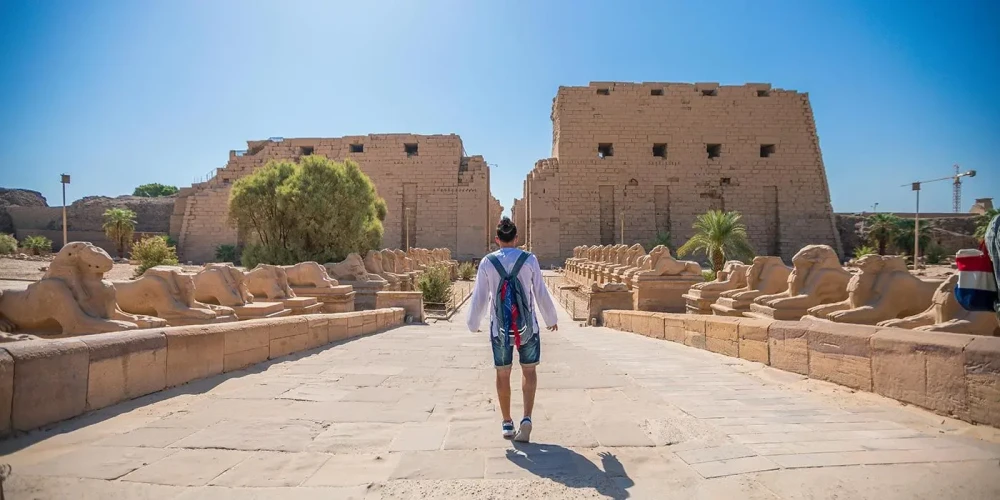
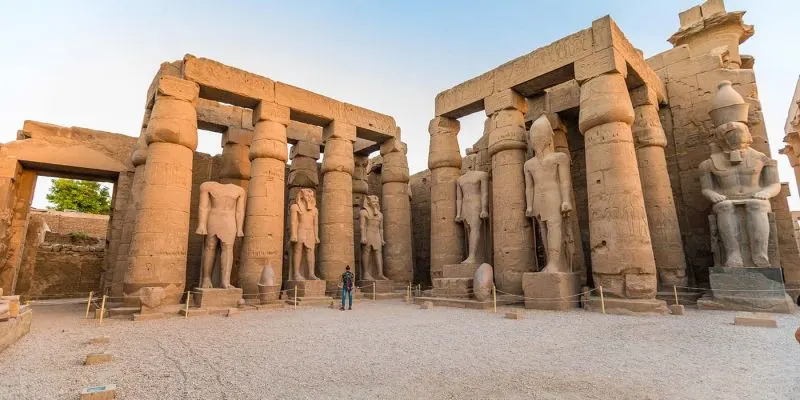
Karnak consists in essence of the same elements as are usually found in a state temple: a pylon, colonnaded court, hypostyle hall, vestibule, shrine and storerooms, but the fundamental plan has been overlaid by extra pylons, added courtyards and colonnades and even subsidiary shrines, the whole time the temple moving further W, presumably following the retreating bank of the Nile. Structures were added by each king who came to the throne so that this extended building period has ensured that the unity present in the mortuary temples built at a single time for a single purpose is missing. To follow the chronological order of the Great Temple of Amun would necessitate beginning a:t the E. However, today, to make sense of the temple it is necessary to enter at the Wend. First is an Avenue of Ram-headed Sphinxes, probably erected by Amenhotep ill or Horemheb but later usurped first by Ramesses II and again by Pinudjem. This leads to the incomplete First Pylon (130m wide). Recent work by the Centre Franco-Egyptien, created in 1967 to coordinate the work at Karnak and preserve the art and architecture of the site, has established that there are several Ptolemaic and Roman levels in front of the pylon. It has been revealed that there are slipways for raising the sacred barks from the canal in front of the temple and a garden planted in front of the sphinxes watered by channels. The exact date of the slipways has not yet been established, but they must be later than the 22 Dyn. as some of the blocks used in their construction bear cartouches of Sheshonq. The First Forecourt (103m by 84m) seems originally to have been planned by the 22 Dyn. rulers, though never completed. On the left on entry is the small Shrine of Seti. II, really a way-station of the sacred barks with chapels to Amun, Mut and Khonsu. It was cleared by Legrain in 1912, previously only the top courses being visible. The structure is of quartzite sandstone and originally stood in isolation in front of the temple. The fac;ade shows Seti malting offerings to different deities and above is a frieze of cartouches and crowned uraei alternating with red and white crowns. Surmounting this is the winged disk of Horus with the inscription 'He of Bhdt, Lord of the Sky, Great God bright of plumage'. Interior scenes show the barks of the gods. The walls are unnecessarily thick, with the hieroglyphics and inscriptions poorly executed. The Set animal used for the king's name has in many cases been erased. The foundations of the building are of stone from the quarries of the Gaba! Ahmar near Cairo. Excavations done for the building of the first pylon close by caused the collapse of the W wall of this structure, damaging the shrine of Mut, but it was subsequently replace~. In the centre ·of the court are ten columns of Taharqa, part of a kiosk some 26.Sm high, of which only one is standing. On the S side of the courtyard is the Temple of Ramesses III (see below), beside which is the Bubasti.te Portal of the 22 Dyn. whose kings originally planned the whole courtyard. It has scenes of Sheshonq's victories over the Palestinians while to the N of the gate are scenes celebrating Prince Osorkon's work as High Priest of Amun. The Second Pylon, called 'filuminating Thebes' a copy of the third pylon, and the vestibule were built by Horemheb. To the left is a colossal standing statue of Ramesses H (15m) with his daughter Benta anta in front of his legs. It was usurped by Pinudjem in the 21 Dyn.'The interior was filled with blocks from a temple of Akhenaten. The small Temple of Ramesses III on the S side of the courtyard is dedicated to Amun in the two forms in which he appears most frequently, 'Amun-Rec, king of the gods and Lord of Karnak' and 'Amun-Rec-Kamutef, he who is before his harim'. It is not certain when it was built but it must have.
SALA HIPÓSTILA
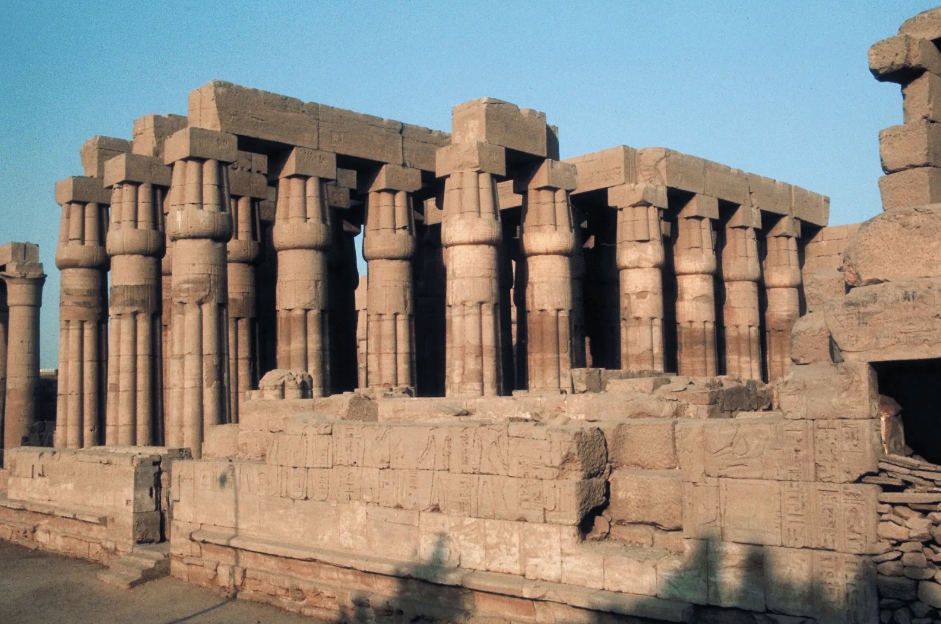
On the inside wall of the second pylon Seti is shown followed by Khonsu and led by Hathor to Amun-Rec. Further Non the same wall are shown Ramesses I before eight divinities; Seti I kneeling before Seth and Nephthys, and Ramesses I before Horus and Hathor, Sobek and Wadjet. In a lower register Seti I is shown with four bulls before Amun and Hathor; the king is also shown before Amun-Rec-Kamutef, with Nubians climbing poles. On the S side of the N wall are some very delicate scenes of Thoth writing Seti's name on the ·sacred ished tree, while the king kneels before him. On the far side of the door the king receives a sceptre, and offers vases to Amun-Rec. On the front of the third pylon there are a further 37 scenes of Seti before the gods receiving serpent sceptres from Mut, pouring libations on an altar, and making offerings in which Ramesses II joins him. The scenes outside on the N wall show Seti's Syrian and Palestinian campaigns, including the capture of the city of Ye~oam, the king driving in his chariot, offering prisoners to Amun-Rec, and returning from his campaigns across the canal that marks the border of Egypt. The N Gate of the Hall leads to the small Temple of Ptah (see below). The S side of the Hypostyle Hall was largely decorated by Ramesses II. On the E face of the third pylon the king is shown before Amun-Rec and on the lintels over the S Gate he is shown running to Amun-Rec and Mut, and again to Amun-Rec and Khonsu. Just E of the door the king is shown in a boat with a goose on the prow before Arnun-Rec. Other scenes show the divine barks carried by priests in procession, and the king adoring the The ban Triad. On the outside of the S wall of the hall are scenes from the battle of Kadesh and his Palestinian and Syrian wars. At the E end prisoners are shown before the Triad of Thebes, while scenes throughout show the capture of Palestinian cities (much damaged), Ramesses II attacking a fortress, and the king binding captives. Beside the gate the king is slaying captives taken in the war.
TERCER PILAR
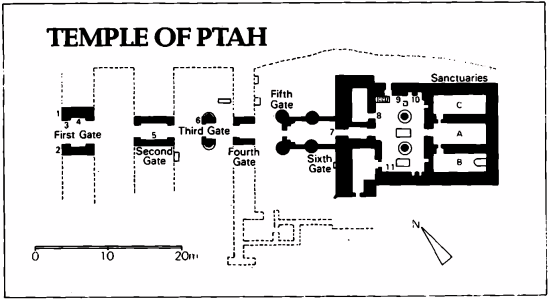
The Third Pylon wa~ built by Amenhotep III. In the foundations were found several dismembered earlier shrines, some complete. They included a limestone Chapel of Senusert I. This was a way station where the boats of the gods could be rested during processions. Beautifully carved, this small chapel has square pillars and a stand on which the boats were laid. An alabaster Chapel of Amenhotep I is not of such high qaulity (both re-erected in an enclosure N of the forecourt called the Open Air Museum. Special permission required for visiting), parts of a quartzite shrine of Hatshepsut (one block in Luxor Museum) and sections of alabaster shrines of Amenhotep II and Tuthmosis IV. On the E face is a long text of Amenhotep, listing tribute while scenes show the sacred boats of the gods. From the hypostyle hall two other temples can be visited. NE against the enclosure wall is the Temple of Ptah and in the S comer of the enclosure the Temple of Khonsu . Between the third and fourth pylons is a small court that originally contained four obelisks, but only one is now standing. The two bases nearest the pylon held obelisks of Tuthmosis III and the blocks are scattered around the court. Beyond these are the bases of the two obelisks ·of Tuthmosis I, of which the southernmost is still standing (23m high, 143 tons), embellished with later cartouches of Ramesses IV and VI. The blocks of the other obelisk are lying on the ground. They were erected by the architect Inneni and would have stood at the entry of the temple as completed by Tuthmosis I. When Amenhotep added the third pylon it boxed the obelisks in the narrow court. At the W end of the court is the Gateway of Ramesses IX to the court and pylons on the N-S axis. To the S lies the Sacred Lake.
Although the Fourth Pylon was constructed by Tuthmosis I, of sandstone faced with limestone, the restoration texts on the outer face are of Tuthmosis IV, Seti II, Shabaka and Ptolemy VIII. It stands in front of a narrow Transverse Hall built by Tuthmosis I or III, now with 14 papyrus columns although probably originally with 16. Hatshepsut had two obelisks erected, one each side of the passageway; only the N one is still standing (27.Sm high, 320 tons). The blocks of the S obelisks are lying in the court with the pyramidion cap removed near to the lake. These two obelisks are depicted in transport from Elephantine to Thebes on the lower terrace at Deir al-Baiµi. Including the quarrying and river transport the process took seven months. They are dedicated to Amun, Presider over Karnak and Lord of Thebes. Another inscription quashes any insolent enquiry from the future as to their purpose thus: 'O ye people who shall see this monument in after years and who shall speak of that which I have made, beware lest you say 'I know not why it was done', I did it because I wished to make them as a gift for my father Amun, and to gild them with electrum'. Tuthmosis Ill's disapproval of Hatshepsut here took the form of encasing the obelisks as far asthe ceiling of the hall. To a great extent this preserved the lower parts, but the upper sections were defaced by Akhenaten.
SALA DE HATSHEPSUT
Formando la pared E del salón transversal se encuentra el Quinto Pilono de piedra caliza con el nombre 'Amón grande de prestigio', también atribuido a Tutmosis I. En la cara W hay imágenes del rey con prisioneros asiáticos. En el mismo lado se conservan los restos de una pequeña Capilla de Amenhotep II. Más allá del pilono se encuentra un Salón Transversal pequeño atribuido a Tutmosis III, dividido por un recinto, las dos secciones conocidas como los Patios Columnados Norte y Sur. Las 20 columnas son algo más pequeñas que las de los salones anteriores. Más allá se encuentra el Sexto Pilono de arenisca de Tutmosis III, llamado 'Amón seguro de prestigio'. Aunque muy dañado, contiene textos históricos interesantes, incluida una lista geográfica de las conquistas del rey. En la cara W hay una lista de pueblos conquistados en la batalla de Megido.
The area beyond the pylon is rather confused, but as after the pylon there is a vestibule flanked by two courts. In the centre of the Vestibule are two granite pillars showing Tuthmosis III embraced by Amun, the N with the symbols of Lower Egypt, the S with those of Upper Egypt. On the N side are two colossi of Amun and Amunetwith the likeness of Tutankhamun. Against the W wall is a seated statue of Amenhotep II. Beginning on the N side and continuing around the walls are the annals of Tuthmosis III. The two flanking courts have the remains of columns indicating their original colonnaded aspect. In the N court a large number of fragmentary statues were found, some of the Middle Kingdom (now in the EM). N and Sare several chapels, now ruined, built by Amenhotep I, usurped by Tuthmosis III. Directly beyond the vestibule is the Granite Sanctuary of Philip Arrhidaeus, the passage around which continues the texts of Tuthmosis III from the vestibule. The king is shown offering to Amun-Rec and accounts are given of the years 23 and 25 of his reign. The exterior of the rose-granite sanctuary has scenes of Philip before Amun-Rec, standards and the king offering and running before Amun. Three registers show the king with deities and boats. The long narrow interior consists ·of two rooms. In the E room are texts giving an account of the building by Philip. It replaced an earlier structure, probably of Tuthmosis III.
En el lado N, un portal de granito oscuro se abre a una serie de salas construidas por Hatshepsut pero alteradas considerablemente por Tuthmosis III, reemplazando sus cartuchos por los suyos. La Sala de Hatshepsut (con cargo adicional por abrir esta sala) fue tapiada por Tuthmosis III, lo que protegió la decoración, y los colores se han mantenido muy vivos. Se ve a Hatshepsut purificada por Thoth y Horus. Al sur del santuario hay otro complejo de salas (desde los escalones de la más al norte de estas se puede obtener una buena fotografía de los barcos). Al este de este complejo se encuentran los bloques de alabastro y piedra caliza dispersos, los restos del templo original de la Dinastía XII que estuvo aquí, construido por Senusert I.
SALA DE FESTIVALES
through a vestibule into the Pillared Hall where the strange plan becomes apparent. The centre columns are of a unique form and are· considered to represent the tent-poles used in the campaign tent of Tuthmosis. They are higher than the square pillars in the side aisles and allowed for the use of clerestory windows. In the small room in the SW comer of the hall were found the stele known as the Karnak Table of Kings (now in the Louvre, No. 13481). On the N side· are the remains of two uninscribed statues and a kneeling figure of Sety n. Behind these are several narrow rooms dedicated to the Triad of Thebes. To the SE is a series of rooms usurped by the Ptolemies,· with one decorated by Alexander the Great. Just N of these is the 'Botanical Room' with reliefs of alien flora and fauna said to have been brought back by Tuthmosis from his foreign campaigns in Asia. Beyond the NE wall of the hall is a room usuqed by Ramesses IV. He is seen on the walls while on the floor is ari altar of Ramesses Ill.
On the E side of this ruined area stands the Festival Hall of Tuthmosis III, unlike any other Egyptian building. Like so much 18 Dyn. work it was erected transversely across the axis of the temple. Called 'Men-Khepheru-Rec, blessed through his monuments', it is 44m long and 17m wide. There is a central naye and at a lower level two side aisles. It was later used as a Christian church.' Entry is from the SW through a vestibule into the Pillared Hall where the strange plan becomes apparent. The centre columns are of a unique form and are· considered to represent the tent-poles used in the campaign tent of Tuthmosis. They are higher than the square pillars in the side aisles and allowed for the use of clerestory windows. In the small room in the SW comer of the hall were found the stele known as the Karnak Table of Kings (now in the Louvre, No. 13481). On the N side· are the remains of two uninscribed statues and a kneeling figure of Sety n. Behind these are several narrow rooms dedicated to the Triad of Thebes. To the SE is a series of rooms usurped by the Ptolemies,· with one decorated by Alexander the Great. Just N of these is the 'Botanical Room' with reliefs of alien flora and fauna said to have been brought back by Tuthmosis from his foreign campaigns in Asia. Beyond the NE wall of the hall is a room usuqed by Ramesses IV. He is seen on the walls while on the floor is ari altar of Ramesses Ill.
GRAN TEMPLO
A girdle wall built by Tuthmosis Ill surrounds the area and beyond the E wall is the Eastern Sanctuary of Amun-Rec, built by Hatshepsut. Cut from a single block of alabaster, it is flanked by two lateral rooms and entered by a vestibule. On either side are the pedestals of two obelisks raised by Hatshepsut, of which nothing else remains. Many small temples and shrines lie to the N of the great temple and it is better to visit them from this point before continuing with the N-S axis of the Great Temple. On the S side of the small court between the third and fourth pylons is the entry to the transverse complex of the Great Temple. It is entered through the doorway onstructed by Ramesses IX which leads into the First Court built by Tuthmosis III. This court is interesting in spite of its ruined state, as a cache containing thousands of royal and private statues was found here in 1902-09. The W wall was decorated by Ramesses II, the most important text being the Hittite Treaty of year 21. On the E wall is a long inscription of Merneptah, some 80 lines, listing his victories. S of this is a copy of the ·Israel Stele' (original, from the destroyed temple of Memeptah on West Bank, now in the EM), which is the only Egyptian text to mention Israel. In front of the pylon at the S end of the court stand several statues, four colossi of Tuthmosis III and to the W three smaller figures, two 13 Dyn. kings and Amenhotep II at the end. Against the pylon face is a Stele of Horemheb. Remains of several buildings were found in the court, the earliest dating to Senusert I, and a complex of Amenhotep I.
TEMPLO DE PTAH
Ramesses II. Straddling the E wall of the court is the much-ruined Jubilee Temple of Amenhotep 11, entered through a pillared portico extending the whole length of the building. Beyond this is the 20-pillared hall with a small square-pillared hall leading off each side, that to the N with a small vestibule. The low reliefs here are of particularly fine workmanship. On the outer walls, probably construe-ted by Horemheb, are blocks of Tutankhamun and Amenhotep III. The walls of the court have reliefs of Horemheb with on the W wall the Battle of Kadesh. In front of the next pylon flanking the entrance are two headless colossi of Horemheb usurped by Ramesses II. On the face of the Tenth Pylon are scenes of the victorious king and against the W side the Horemheb Stele giving an account of his reforms. A granite gateway leads through the pylon which was also constructed by Horemheb. Incorporated within it are more talatat of Akhenaten. In the thickness Horemheb is seen before the gods, including Amun-Rec. Directly outside the pylon, which was the S face of the temple, are the remains of two colossi; that on the W of Amenhotep III and that on the E Amenhotep II.
Templo de Luxor
the beginning of the 19C LUXOR (Ar. al-Uqsur1 the Palaces) was a small undistinguished provincial village in the province of Qena. Its fame for Muslims derived from the grave of Abu 1-l;lajjaj, a 12C shaykh, whose tomb was and is still the object of reverence (see below). Although the name given to the area by the Muslims acknowledged their appreciation of the number of ancient buildings, most of the monuments on the East Bank were buried and those exposed were neglected or used as habitations. Those on the West Bank, save the Colossi of Memnon, were almost totally unknown. Several of the early European explorers mentioned the area but it was not until the survey of Napoleon's expedition that the importance of the site became apparent. Even so, many discoveries remained to be made and an almost continual programme of excavation has revealed, and continues to reveal, sites of the greatest importance. The new-found fame of the site attracted an increasing number of visitors during the early 19Ci when Thomas Cook inaugurated his tourist route the number rose dramatically and hotels were built to house them. In 1896 it was made the chief town of the district which increased its importance and in 1985 it was given the status of a province. It is now the most important tourist site in Upper Egypt and the present aspect is that of a· modem town with hospitals, shops,
Museo de Luxor
Situado en la Corniche, el Museo de Luxor es ampliamente considerado uno de los museos mejor curados del mundo. Alberga una colección de clase mundial de artefactos encontrados en las tumbas y templos circundantes. La presentación es científicamente meticulosa, con piezas bien iluminadas que muestran la evolución artística del Nuevo Reino. Visitar este museo proporciona el contexto necesario para apreciar la pura habilidad artesanal de las estatuas que se ven en los sitios arqueológicos más grandes.
Valle de los Reyes
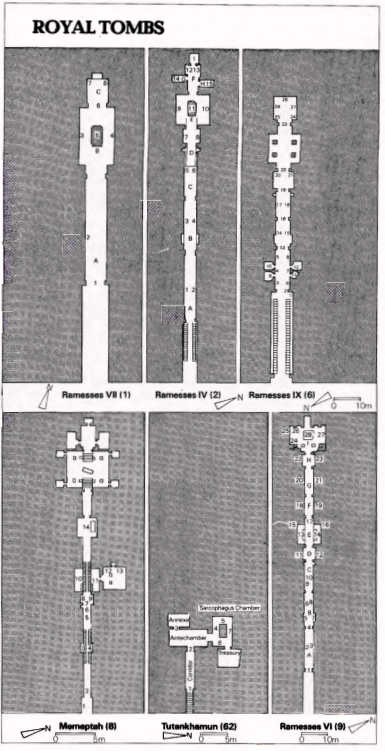
The road to the NW is the SIKKAT AL-WADA YN (Track of the Two Valleys). It passes on the SW a track to the S monuments and to the N Howard Carter's House on the bluff immediately above. The NW road curves through a valley leading after 3. 75km to the *Valley of the Kings (Ar. Biban al-Muliik; Tombs of the Kings, or Wadi al-Muliik; as English, a local name bestowed ·by inspired guesswork rather than of direct knowledge of the function of the area. Open 08.00-18.00. but negotiable and special ti.mes can be arranged. Resthouse with refreshments inside valley. Fee). It consists of two main sections, the E valley where most of the tombs (not all accessible) are located and the W valley with only two royal and two other tombs (special permission required). Han early visit is wanted, prior arrangements should be made (at agency in Luxor) so that the tombs can be opened and illuminated. Although most are lit by electricity (e.l.), this occasionally fails and for this reason, and to see others that are not lit, it is advisable to take a torch. Those that can be visited are so large and contain so much material that it is not practicable to see more than four or five at one time; it is better where possible to make two or more visits. I tis best to visit the site as. early in the day as possible. After 11.00 large groups start to arrive.
Valle de las Reinas
Beyond Qumat Mura9: (500m) the road passes (W) the destroyed Temple of Merneptah and arrives at a crossroads. To the SW lies Madinat Habii. Take the road to the W to the Valley of the Queens (Ar. Biban al-I:Iarim or Biban al-Malikat: of the Ladies or of the Queens) which runs E to W. Toilets to the left of car park. Towards the middle of the 18 Dyn. this valley was used for the burial of several high officials. Most of the wives of the 18 Dyn. rulers were buried in the same tombs as their husbands and it was not until the 19 Dyn. that this area was used for the wives and children of the royal family. Called the 'Place of Beauty', it was utilised throughout this and the following dynasty but then gradually fell into disuse. The earliest royal tomb seems to be that of Queen SitReu, wife of Ramesses I, while the most notable is that of Queen Nefertari, wife of Ramesses II. There are nearly 80 tombs in these shallow valleys but many of them are unnamed or uninscribed, or if inscribed the cartouches are often left blank. Unlike those in the Valley of the Kings, these are small tombs easily entered and with brightly coloured wall paintings. The plan usually consists of a small antechamber, long narrow corridor, several side chambers, many of which are undecorated, and at the end the tomb-chapel. Most of these tombs were cleared by the Italian Egyptologist Schiaparelli before World War I. Normally, unless there is a great deal of time, only three tombs are visited: those of Queen Tyti (No. 52), Prince Amun-hir-Khopshef (No. 55) and Prince Kha'emweset (No. 44).
Ramesseum
Ramés II construyó su templo mortuorio, el Ramesseum, como una declaración duradera de su reinado de 67 años. Dedicado al dios Amón, el complejo tardó casi 20 años en completarse. Aunque gran parte de él está en ruinas, las columnas en pie y los fragmentos colosales de una estatua de granito (que pesa más de 1,000 toneladas) reflejan el auge de la ingeniería mecánica egipcia y la capacidad de transportar y tallar enormes bloques líticos.
MorgueTemplo de Hatshepsut
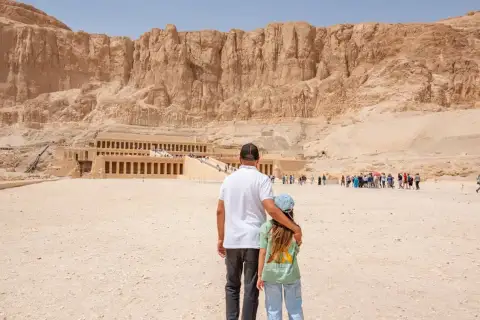
Templo mortuorio de Hatshepsut, situado en un pliegue de las colinas tebanas con los acantilados como un espléndido telón de fondo. Diseñado y construido por el mayordomo y arquitecto de Hatshepsut, Senenmut, se eleva en una serie de terrazas hasta el santuario. Era conocido como Djer-Djeseru y ella lo dedicó a su padre Tutmosis I, Amón-Unido-con-la-Eternidad, y a sí misma, en un lugar probablemente ya sagrado para Hathor en su aspecto de Diosa del Oeste.
Este templo es una de las estructuras más notables de Egipto. Se dice que fue inspirado por las capillas funerarias de algunos de los nobles del Reino Medio en Qaw al-Kabir (Medio Egipto), pero cualesquiera que sean los antecedentes, el resultado es muy impactante. Recientemente se han descubierto y ampliado los muros construidos por Senenmut para contener la roca friable. Mucho tiempo después de que el templo fuera abandonado, se utilizó como un monasterio copto, Theier al-Baliri, cuyo nombre ahora se usa para toda la zona. Examinado por primera vez por los sabios de Napoleón, fue parcialmente despejado por Wilkinson, pero fue Lepsius quien comprendió la conexión entre este sitio y el trabajo de Hatshepsut en Karnak.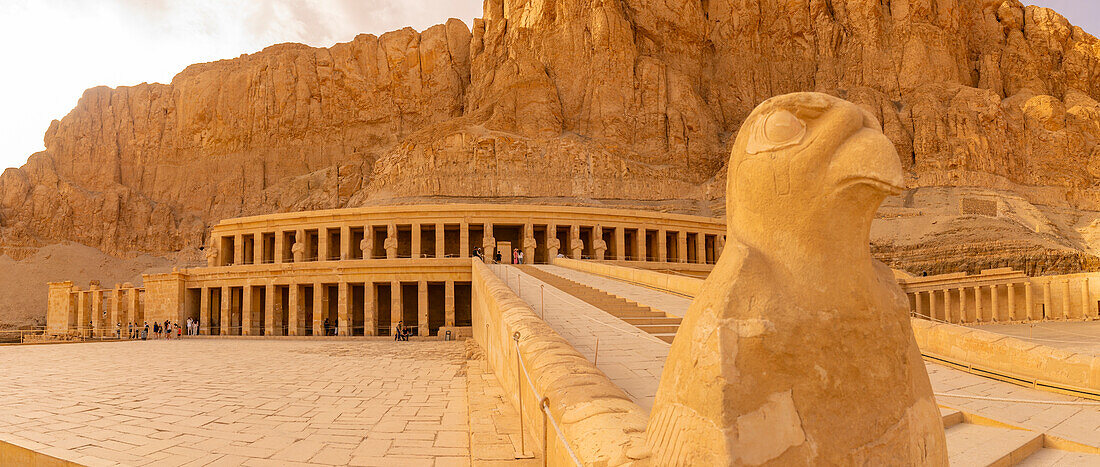
Medinat Habu
El Templo de Ramsés III en Medinat Habu es quizás el templo mejor conservado en Luxor. Su escala masiva es superada solo por Karnak. Los relieves coloridos permanecieron intactos durante siglos porque los primeros cristianos cubrieron las paredes con yeso para ocultar las imágenes paganas, preservando involuntariamente los colores originales de la Dinastía XX. Los pilonos sirven como un registro militar, detallando las campañas del faraón contra los "Pueblos del Mar".
Deir el-Medina
Deir al-Madinah (usually called the Workmen's Tombs) which belong to the artisans who constructed the great tombs (mainly 19-20 Dyns). The typical tomb-chapel seems to consist of two parts, a rock-cut chapel and an underground tomb-chamber. The chapel appears to reproduce the same elements found in the f:olew Kingdom house, namely (a) a rock-cut court at the rear of which is a centre door opening into (b) a transverse hall, corresponding to the broad hall or reception area of the private house, running from which is (c) a corridor, cut deep into the native rock, at the far end of which is (d) a niche for statues or sometimes a small chapel or shrine, where the offerings were made and the funerary rite performed. At each end of the first broad hall is a stele, one with biographical details, the other a false door. Deir al-Madinah chapels become irregularly shaped with a chapel in the form of a small pyramid at the top and steps down to a small burial chamber. Since the quality of the stone improves with elevation of the hill the more important officials are usually buried higher up the slope.
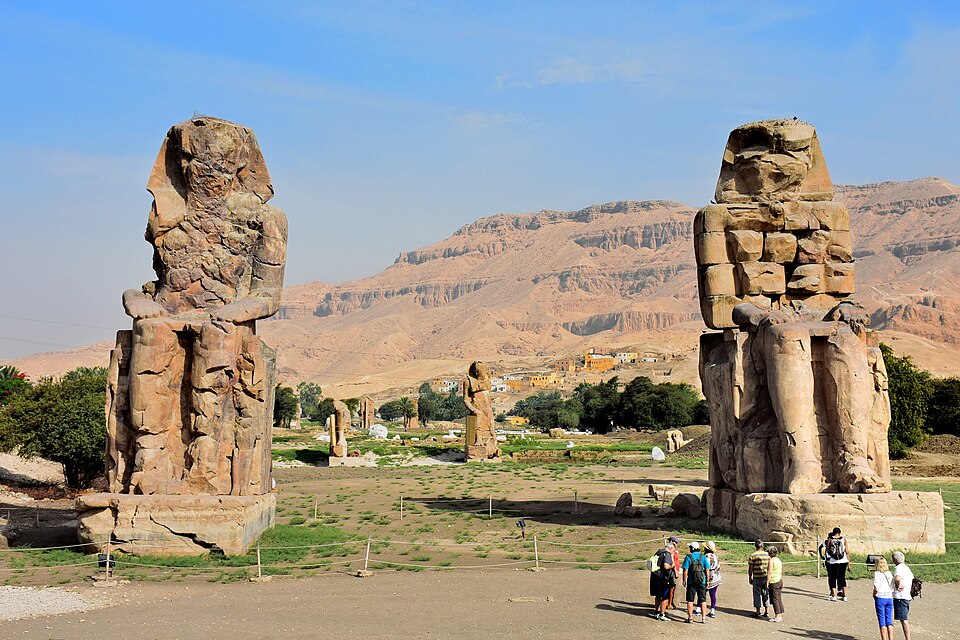
Colosos de Memnón
Sigue por la carretera hacia el sureste con un canal a la derecha. Esta carretera eventualmente lleva de nuevo al ferry. Después de 600 m al norte se encuentran los Colosos de Memnón. Estas dos enormes figuras de Amenhotep III se sentaban frente al templo mortuorio del rey.