
 English
 Italy
Italy
-webp.webp "Dahabiya Cruise")
Comparing Dahabiya Cruise Costs: Is it Worth the Extra Price?
If you have spent any time scrolling through travel forums or looking at brochures for Egypt in 2026, you have likely encountered a major price discrepancy. On one hand, you have the massive, multi-story "Floating Hotels"—the large cruise ships that carry 100 to 200 passengers, Our Egypt Nile Cruises are the most exciting in Egypt tours.
On the other hand, you have the Dahabiya: a traditional, wooden, twin-masted sailboat that looks like something out of an 18th-century painting.
The price tag for Dahabiya Nile Cruises can easily be double or triple that of a standard large cruise. For many travelers, this leads to one burning question: Is it actually worth the extra money? When you are looking at the 2026/2027 season, the answer depends entirely on what you value in a vacation. To help you decide if you should splash out for the sailboat or stick to the ship, let’s break down exactly what that extra cash buys you in terms of experience, access, and sanity.
1. The Luxury of Silence vs. the Engine’s Hum
The most immediate difference between a budget large ship and a luxury Dahabiya is the sound. Large cruise ships are powered by massive diesel engines that run 24/7 to keep the air conditioning and lights working. Even when docked, you can hear the low-frequency vibration of the generators.
-
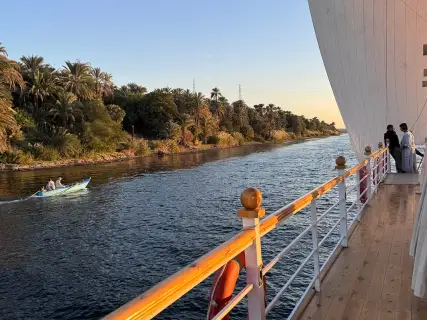
The Dahabiya Advantage: A Dahabiya is designed to sail. When the wind is right, the crew unfurls the massive lateen sails, and you glide down the Nile in near-total silence. In 2026, the highest-end Dahabiyas (like the Movenpick SB Feddya or Nour El Nil) use "silent generators" and high-capacity battery banks, so even when the sails are down, you don’t have that mechanical rattling in your ears.
-
Is it worth the price? If you are a light sleeper or someone who treasures peace and quiet, yes. The ability to hear the birds on the riverbanks and the call to prayer from distant villages in Aswan without the roar of an engine is a primary reason people pay the premium.
2. Exclusive Access: Docking Where the Giants Can't
The Nile has changed over the thousands of years, and many of its most beautiful ancient sites are located in shallow waters or narrow stretches.
-
The Large Ship Constraint: Big cruisers are restricted to specific, high-traffic docks in Luxor, Edfu, Kom Ombo, and Aswan. This means when you get off the boat, you are surrounded by thousands of other tourists all trying to enter the temple at the same time.
-
The Dahabiya Advantage: Because of their shallow draft and smaller size, Dahabiyas can dock anywhere. They can tie up to a palm tree on a remote island or dock directly at Gebel el-Silsila—a stunning ancient sandstone quarry that large ships literally cannot reach.
-
Is it worth the price? If your goal is to see "Hidden Egypt" and avoid the "Disney-fied" crowds at the main gates, the Dahabiya is the only way to do it. You’ll often find yourself standing in an ancient tomb or a local village where you are the only foreigner in sight.
3. Culinary Excellence: From Buffets to Farm-to-Table
Food on the Nile has a reputation for being... hit or miss. On large ships, cooking for 150 people usually means buffet-style meals where the quality can be a bit industrial.
-
The Dahabiya Advantage: On a Dahabiya, you have a private chef cooking for a maximum of 12 to 20 people. In 2026, the luxury standard is "Nile-to-Table." The chef will often jump off the boat at a local village to buy fresh fish, vegetables, and bread from farmers they have known for years.
-
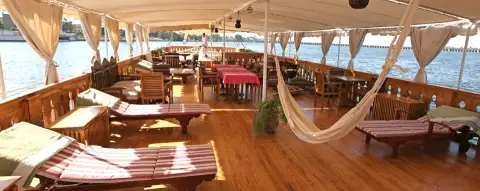
The Experience: You aren't just eating in a dining room; you’re having candlelit dinners on the sundeck or a BBQ on a private sandbank under the stars.
-
Is it worth the price? If you are a "foodie" or have specific dietary requirements (Vegan, Gluten-Free, Halal), the personalized attention of a private chef is worth every penny. You get to eat authentic Egyptian cuisine that hasn't been sitting in a warming tray for three hours.
4. The "Intimacy" Factor: Service That Knows Your Name
On a large ship, you are "Cabin 304." On a Dahabiya, you are a guest in a home.
-
The Staff Ratio: A luxury Dahabiya Nile Cruise typically has a crew of 10 to 12 people serving just 8 to 12 guests. This means the staff knows exactly how you like your coffee and when you prefer your afternoon tea.
-
The Egyptologist: On a big cruise, your guide might be leading a group of 20 to 30 people with headsets. On a Dahabiya, your Egyptologist lives on the boat with you. They become a friend and a mentor, offering evening lectures or deep-dive discussions over a glass of wine at sunset.
-
Is it worth the price? For those traveling for a milestone event (like a 50th birthday or a honeymoon), the personalized service makes the trip feel like a celebration rather than just a tour.
Comparing the 2026 Price Tags
To make a fair comparison, let's look at the average cost for a 4-night/5-day journey in the 2026/2027 season:
| Feature | Large Cruise Ship (5-Star) | Luxury Dahabiya |
| Typical Cost (PP) | $600 – $1,100 | $2,200 – $4,500 |
| Atmosphere | High-energy, social, busy | Quiet, intimate, soulful |
| Itinerary | The "Big Four" temples only | Includes remote islands & quarries |
| Dining | Buffet & Set Menu | Private Chef / A la Carte |
| Internet | Often paid / Slow | High-speed Starlink (Free) |
Is it Worth It?
The Dahabiya is NOT worth it if:
-
You are on a strict budget and want to see the main sites as cheaply as possible.
-
You enjoy the social energy of a large group and want nightly entertainment shows like "Belly Dancing" or "Tannoura."
-
You want the amenities of a large hotel, like a gym, a massive spa, or multiple swimming pools.
The Dahabiya IS worth the extra price if:
-
You want to experience the Nile as it was 100 years ago—slow, quiet, and romantic.
-
You are a history enthusiast who wants deep, private access to archaeological sites without the crowds.
-
You value privacy and high-end, personalized service over "flashy" amenities.
-
You want to support a more sustainable, "low-impact" form of tourism that gives back more directly to the local villages along the river.
As of 2026, the divide between a “tourist” and a “traveler” can not be bigger. A Dahabiya Nile Cruise presents itself as authentic of an Egyptian journey compared to large ship excursions and tour group arrangements to the ancient sites as you can get when you want to see the great Pyramids. If you are one of the travelers who loves to find out about all the secrets and details as we would as we arrange the most excellent of Egypt Tours, take a journey in a Dahabiya Nile Cruise and see the beauty of the Nile not with only your eyes. The slow cruise on the Dahabiya gives traveler the opportunity to have an authentic feel of the Nile, local life style and get to parts that other modes of transport cannot.






-webp.webp "Hilton")
-webp.webp "dusit")
-webp.webp "Marriott Hotels")
-webp.webp "Azimut Hotel")
-webp.webp "Golden Tulip")
-webp.webp "sheraton")
-webp.webp "westin hotel")
-webp.webp "Movenpick")
